
Over half of British families believe moving house is one of life’s most stressful events, yet the reality is much more layered. When families across the North East of England face a relocation, the demands go far beyond boxing up belongings and hiring a van. Reliable, professional packing and storage can transform a chaotic move into a smooth new start. This guide sheds light on surprising truths about house moves, helping you challenge misconceptions and prepare for a confident, worry-free transition.
Table of Contents
- Defining House Moves And Misconceptions
- Life Events Prompting Relocation
- Changing Housing Or Lifestyle Needs
- Financial Factors Influencing House Moves
- Barriers And Challenges When Moving
Key Takeaways
| Point | Details |
|---|---|
| Understanding House Moves | House moves are normal responses to life changes, not solely stressful events, enriching personal growth opportunities. |
| Life Events and Mobility | Significant transitions such as career changes and family dynamics often prompt relocations to better align living arrangements with evolving needs. |
| Financial Considerations | Economic factors play a crucial role in moving decisions, requiring thorough assessments of costs, market conditions, and long-term benefits. |
| Challenges of Relocation | Moving is a multifaceted journey that can involve psychological and practical obstacles, necessitating comprehensive strategic planning to overcome barriers. |
Defining House Moves And Misconceptions
Residential mobility is far more nuanced and dynamic than most people understand. House moves are not simply disruptive events, but essential adaptations to life’s changing circumstances. Research from University College London suggests that moving is actually a normal process of adjusting dwelling and neighbourhood attributes to match evolving personal needs and preferences.
Contrary to popular belief, moving house is not an abnormal or purely stressful experience. The English Housing Survey reveals fascinating insights into residential mobility patterns. Statistical data demonstrates that different demographic groups move for diverse reasons, with younger households and private renters being particularly mobile. This challenges the misconception that moving is an extraordinary or uncommon life event.
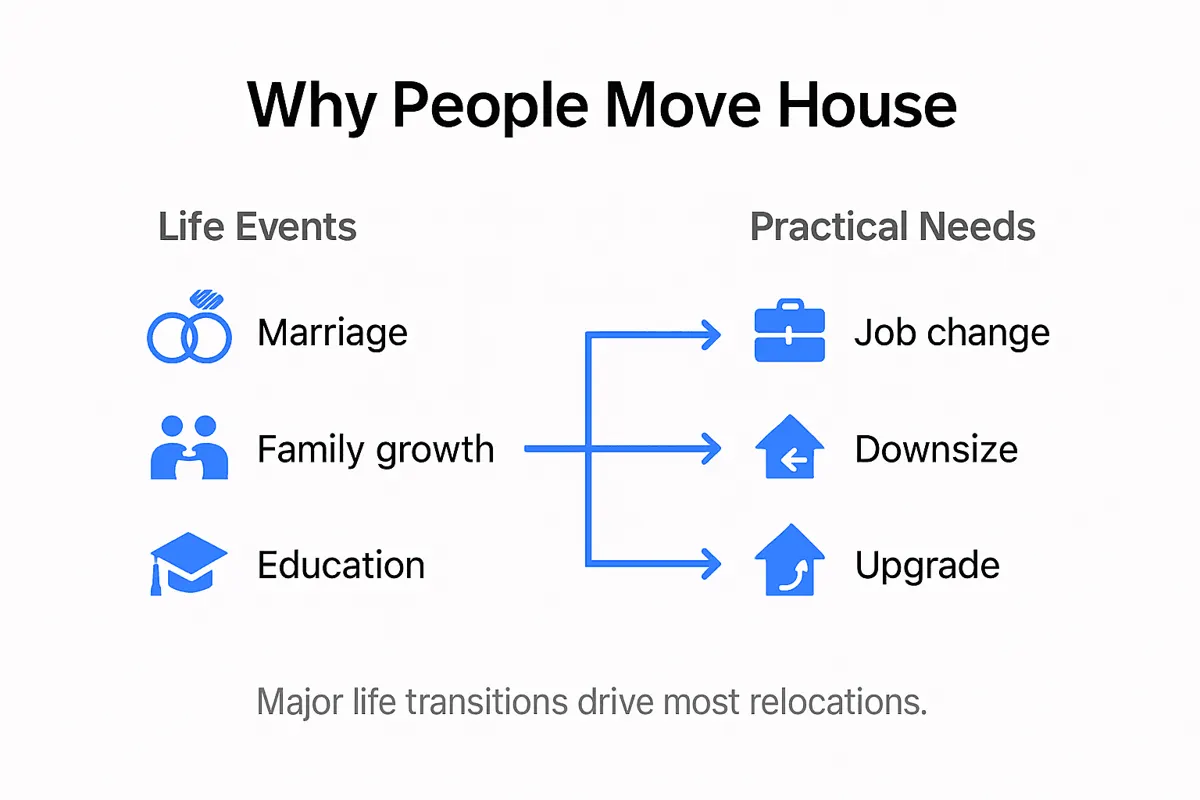
Understanding residential mobility requires recognising its complex social dynamics. Moves frequently result from significant life transitions such as career changes, family expansion, relationship shifts, or seeking better educational opportunities. These are not disruptions but strategic adaptations that help individuals and families optimise their living environments and support networks.
Top Moving Insight: Always view house moves as opportunities for personal growth and positive life transitions, not just logistical challenges.
Life Events Prompting Relocation
Residential mobility is fundamentally shaped by significant life transitions that compel individuals and families to reconsider their current living arrangements. Comprehensive research from University College London reveals that moves are strategic responses to evolving personal circumstances, driven by targeted motivations such as employment opportunities, family dynamics, and cultural considerations.
Employment changes represent a critical catalyst for relocation. Professionals in cities like Durham, Newcastle, and Darlington frequently relocate to pursue career advancements or follow job opportunities across the North East region. The motivations range from promotions requiring geographical shifts to seeking more competitive job markets that align with individual career trajectories.
Family dynamics also play a pivotal role in triggering residential moves. Life stages such as marriage, having children, supporting ageing parents, or managing relationship transitions often necessitate housing changes. Government housing statistics confirm that younger households are particularly prone to mobility, reflecting the fluid nature of personal circumstances and the need to adapt living arrangements accordingly.
- Career progression opportunities
- Family size changes
- Relationship transitions
- Educational requirements
- Financial considerations
Pro Moving Tip: Plan your relocation around key life events by creating a flexible moving strategy that anticipates potential future changes.
The following table summarises how typical life events influence house moving motivations:
| Life Event | Impact on Housing Needs | Common Relocation Reason |
|---|---|---|
| Career advancement | Requires proximity to new workplace | Reducing commute, accessing markets |
| Marriage or relationship | Need for larger or joint living space | Starting shared household |
| Having children | Desire for more space and amenities | Accessing school catchment areas |
| Supporting ageing parents | Requirement for accessible features | Moving closer for caregiving support |
| Education changes | Proximity to institutions | Gaining access to better schools |
Changing Housing Or Lifestyle Needs
Housing requirements continuously evolve throughout our lifetime, reflecting the dynamic nature of personal circumstances and aspirations. Research from housing experts highlights that individuals frequently relocate to improve their quality of life, seeking environments that better align with their current needs and future ambitions.

Space constraints often trigger significant housing transitions. Families in areas like Durham and Newcastle might outgrow their current homes, necessitating moves to accommodate expanding households or changing work arrangements. The rise of remote working has particularly accelerated this trend, with many professionals seeking properties that can seamlessly integrate home office spaces and provide more flexible living environments.
Housing evidence demonstrates that lifestyle needs become increasingly nuanced with age. Older adults, for instance, may contemplate downsizing or relocating to properties with better accessibility features. These decisions are complex, involving considerations such as:
- Proximity to healthcare facilities
- Reduced maintenance requirements
- Enhanced social connectivity
- Improved mobility options
- Financial efficiency
Smart Moving Strategy: Anticipate your future lifestyle needs by conducting a comprehensive assessment of your current and projected living requirements before making a relocation decision.
Financial Factors Influencing House Moves
Property economics play a pivotal role in determining residential mobility across the United Kingdom. Housing research reveals that financial considerations extend far beyond simple cost calculations, involving complex interactions between personal circumstances, market conditions, and individual financial capabilities.
In regions like County Durham and the North East, property prices and mortgage availability significantly impact moving decisions. Younger households face substantial barriers, with deposit requirements and fluctuating housing markets creating substantial challenges. Professionals in cities such as Newcastle and Darlington often find themselves strategically planning moves based on intricate financial calculations that balance career opportunities, housing affordability, and long-term investment potential.
Recent financial analysis highlights that affordability constraints are becoming increasingly complex. Key financial considerations include:
- Stamp duty implications
- Mortgage accessibility
- Property valuation trends
- Potential investment returns
- Relocation expenses
Ultimately, financial decisions around moving involve balancing immediate costs with long-term quality of life aspirations. Each relocation represents a nuanced economic calculation that extends beyond simple monetary considerations.
Financial Planning Tip: Conduct a comprehensive financial assessment at least six months before considering a move, examining both immediate expenses and potential long-term economic benefits.
Below is a comparison of common financial challenges faced by different demographic groups when moving:
| Demographic Group | Main Financial Challenge | Typical coping strategy |
|---|---|---|
| Younger households | High deposit requirements | Relying on parental support |
| Families | Balancing space and affordability | Seeking out-of-centre properties |
| Professionals | Fluctuating market conditions | Timing moves for market dips |
| Older adults | Costs of downsizing | Using equity release options |
Barriers And Challenges When Moving
Moving house represents a complex psychological and practical journey fraught with unexpected challenges. Contemporary research highlights that individuals face numerous obstacles beyond simple logistical considerations, ranging from emotional attachments to financial constraints.
In the North East, particularly across County Durham and cities like Newcastle and Darlington, residents encounter distinctive moving challenges. These include navigating local property markets, managing emotional connections to current neighbourhoods, and addressing practical concerns about relocation. Some individuals find themselves paralysed by the fear of disrupting established social networks or leaving familiar community environments.
Qualitative studies demonstrate that moving barriers are deeply intertwined with personal psychological experiences. Key challenges typically include:
- Emotional attachment to current home
- Financial uncertainty
- Fear of the unknown
- Limited suitable property options
- Complex administrative processes
Professionals and families must recognise that moving represents more than a physical transition. It involves navigating complex emotional, social, and economic landscapes that require careful strategic planning and emotional resilience.
Strategic Preparation Tip: Develop a comprehensive moving strategy that addresses both practical logistics and potential emotional challenges at least three months before your planned relocation.
Simplify Your House Move With Trusted Experts
Moving house can be a significant life transition driven by career progression, family changes, or the need for a better lifestyle. These key motivations often bring stress and challenges such as managing logistics, emotional attachments, and financial planning. At Schott Removals, we understand these complexities and offer tailored moving solutions to ease your journey every step of the way.
Discover peace of mind with our professional services offering local and national removals, expert packing, secure storage, and international shipping. Benefit from over 30 years of industry experience based in Darlington, trusted by families and professionals across the UK and Europe. Our detailed Testimonial Showcase highlights the satisfaction and reliability we bring to every move.

Start your move with confidence today. Visit Schott Removals to explore our comprehensive services and use our easy online quoting tool. Preparing your move around your key life events has never been easier with expert guidance from our dedicated team ready to support your transition. For helpful insights and practical advice, see our Uncategorised Archives.
Take control of your next chapter now and partner with a company that puts your needs first.
Frequently Asked Questions
Why do people move house?
People move house for various reasons, including career changes, family dynamics, lifestyle changes, financial considerations, and educational opportunities. Relocation is often a strategic response to evolving personal circumstances.
What are common life events that prompt people to relocate?
Common life events include career advancement, marriage, having children, supporting ageing parents, and educational needs. These transitions often necessitate a change in housing to better suit new family dynamics and requirements.
How can financial factors influence the decision to move?
Financial factors, such as property prices, mortgage availability, stamp duty implications, and the cost of relocation, significantly impact moving decisions. Individuals often assess their financial capabilities against housing market trends to inform their choices.
What challenges do people face when moving house?
Challenges can include emotional attachments to the current home, financial uncertainties, fear of the unknown, limited available properties, and complex administrative processes. These factors require careful planning and can influence the ease of transitioning to a new home.
Recommended
- Best Time to Move House in the UK: Guide for 2025 & Beyond | Schott Removals
- House Removal Process Explained: Step-by-Step Guide for 2025 | Schott Removals
- Cost to Move House UK 2025: Guide for Homeowners and Businesses | Schott Removals
- When to Schedule Your Move: Essential Guidance for 2025 in the North East | Schott Removals
- Panoramic windows – KT Costruction