
Moving from County Durham to London or considering a new start in Northumberland presents a mix of opportunity and challenge. The North-South divide in England means big differences in housing costs, job options, and community life. Understanding these contrasts helps families and professionals make sense of what to expect, whether seeking affordable property in Darlington or higher wages in Surrey. Discover key insights to make your packing and removal process smoother and your relocation decision smarter.
Table of Contents
- Defining North East vs South Moves in the UK
- Key Differences: Cost, Housing, and Lifestyle
- Influence of Jobs and Local Economies
- Trends Shaping Relocation in 2026
- Choosing the Right Move: Risks and Tips
Key Takeaways
| Point | Details |
|---|---|
| Economic Disparities | The North-South divide significantly affects housing affordability, employment opportunities, and quality of life. Individuals should research these differences thoroughly before relocating. |
| Employment Landscape | Job availability varies between regions, with the South showing more diverse job opportunities while the North offers more stable public sector employment. Prospective movers should evaluate their industry-specific options carefully. |
| Lifestyle Considerations | Relocation involves more than finances; factors such as community atmosphere and work-life balance are crucial. Consider how these elements align with personal preferences when planning a move. |
| Emerging Trends | Changes such as remote work and regional investments are reshaping migration patterns. Staying informed about these trends can help individuals identify potential relocation opportunities. |
Defining North East vs South Moves in the UK
The geographical dynamics of moving between the North East and South of the United Kingdom represent a complex landscape of economic, cultural, and social considerations. Historic economic divisions have long characterised the relationship between these distinct regions, creating unique challenges and opportunities for individuals and families contemplating relocation.
Understanding the North-South divide requires examining several critical dimensions:
- Economic disparities between regions
- Employment opportunities
- Infrastructure variations
- Living cost differences
- Cultural and social environments
Traditionally, the North East encompasses areas like County Durham, Northumberland, and Darlington, while the South includes regions such as London, Surrey, and Sussex. These areas differ substantially in economic output, employment rates, and lifestyle characteristics. The North-South economic divide remains a significant factor influencing population movement and regional development strategies.
Moving between these regions involves more than simple geographical transition. Families and professionals must consider nuanced factors like career prospects, housing affordability, lifestyle preferences, and potential cultural adjustments. Each move represents a unique personal journey shaped by individual circumstances and regional characteristics.
Pro tip: Research local job markets, housing costs, and community infrastructure thoroughly before planning a North-South relocation to ensure a smooth transition.
Key Differences: Cost, Housing, and Lifestyle
The economic landscape of moving between the North East and South of England presents a complex array of financial and lifestyle considerations. Economic disparities between regions significantly impact housing affordability, employment opportunities, and overall quality of life for individuals contemplating relocation.
Key comparative aspects include:
- Housing prices and affordability
- Average income levels
- Employment opportunities
- Cost of living expenses
- Regional infrastructure quality
Housing represents a critical differentiator in North-South moves. Regional economic variations demonstrate substantial differences in property markets. Southern regions, particularly around London, feature dramatically higher property prices and living costs compared to more affordable northern areas like County Durham and Northumberland. A typical three-bedroom house in Darlington might cost significantly less than an equivalent property in Surrey or Sussex.

Lifestyle variations extend beyond pure economic metrics. Southern urban centres offer more diverse job markets and service-oriented economies, while northern regions provide stronger community connections and potentially lower stress environments. Professionals and families must carefully weigh these nuanced factors, considering not just financial implications but also personal preferences in work-life balance and community atmosphere.
Here is a side-by-side view of regional lifestyle differences influencing relocation decisions:
| Aspect | North East England | Southern England |
|---|---|---|
| Average house price | More affordable, lower property tax | Significantly higher, pricier market |
| Community atmosphere | Close-knit, local events common | Diverse, more transient populations |
| Job market focus | Public sector, manufacturing | Financial, technology, creative hubs |
| Commuting patterns | Shorter, less congested routes | Longer, often crowded transport |
| Stress environment | Calmer, lower pace of life | Fast-paced, greater work pressure |
Pro tip: Create a comprehensive spreadsheet comparing living costs, salary expectations, and housing prices between your current and potential new region to make an informed relocation decision.
Influence of Jobs and Local Economies
The employment landscape across the United Kingdom reveals stark contrasts between the North East and Southern regions, fundamentally shaping migration and economic opportunities. Regional economic disparities profoundly impact job availability, career progression, and individual relocation decisions.
Key employment characteristics include:
- Sector diversity
- Wage differentials
- Job market resilience
- Skills demand
- Economic growth potential
The North East has historically faced significant economic challenges, particularly following widespread deindustrialisation. Structural economic differences mean the region relies more heavily on public sector employment and fiscal transfers, whereas Southern economies, especially around London, demonstrate more dynamic and diverse economic activity.
Professionals considering relocation must carefully evaluate sector-specific opportunities. Financial services, technology, and creative industries predominantly cluster in Southern urban centres, offering higher salaries and more sophisticated career paths. Conversely, the North East provides unique advantages such as lower living costs, potentially more stable employment in public sectors, and emerging opportunities in renewable energy and advanced manufacturing.
Pro tip: Conduct detailed research into your specific industry’s regional job market performance, considering not just current opportunities but also projected growth trends and emerging sector developments.
Trends Shaping Relocation in 2026
The migration landscape of the United Kingdom is undergoing significant transformations, driven by complex policy shifts and emerging economic strategies. Government devolution policies are fundamentally reshaping regional dynamics, creating unprecedented opportunities for individuals considering relocation between the North East and Southern England.
Key relocation trends for 2026 include:
- Remote work flexibility
- Policy-driven regional investment
- Economic rebalancing initiatives
- Technological innovation hubs
- Changing workforce demographics
Economic reform strategies are introducing novel incentives that could dramatically alter traditional migration patterns. Emerging policies targeting the North are designed to reduce economic disparities, potentially making regions like County Durham and Northumberland more attractive for professionals seeking affordable living and emerging career opportunities.
Technological advancements and remote working models are dismantling traditional geographical constraints. Professionals can now consider relocations that balance lifestyle preferences with career aspirations, moving beyond the conventional North-South binary. The rise of digital infrastructure and decentralised work environments means individuals have unprecedented flexibility in choosing their ideal living and working locations.
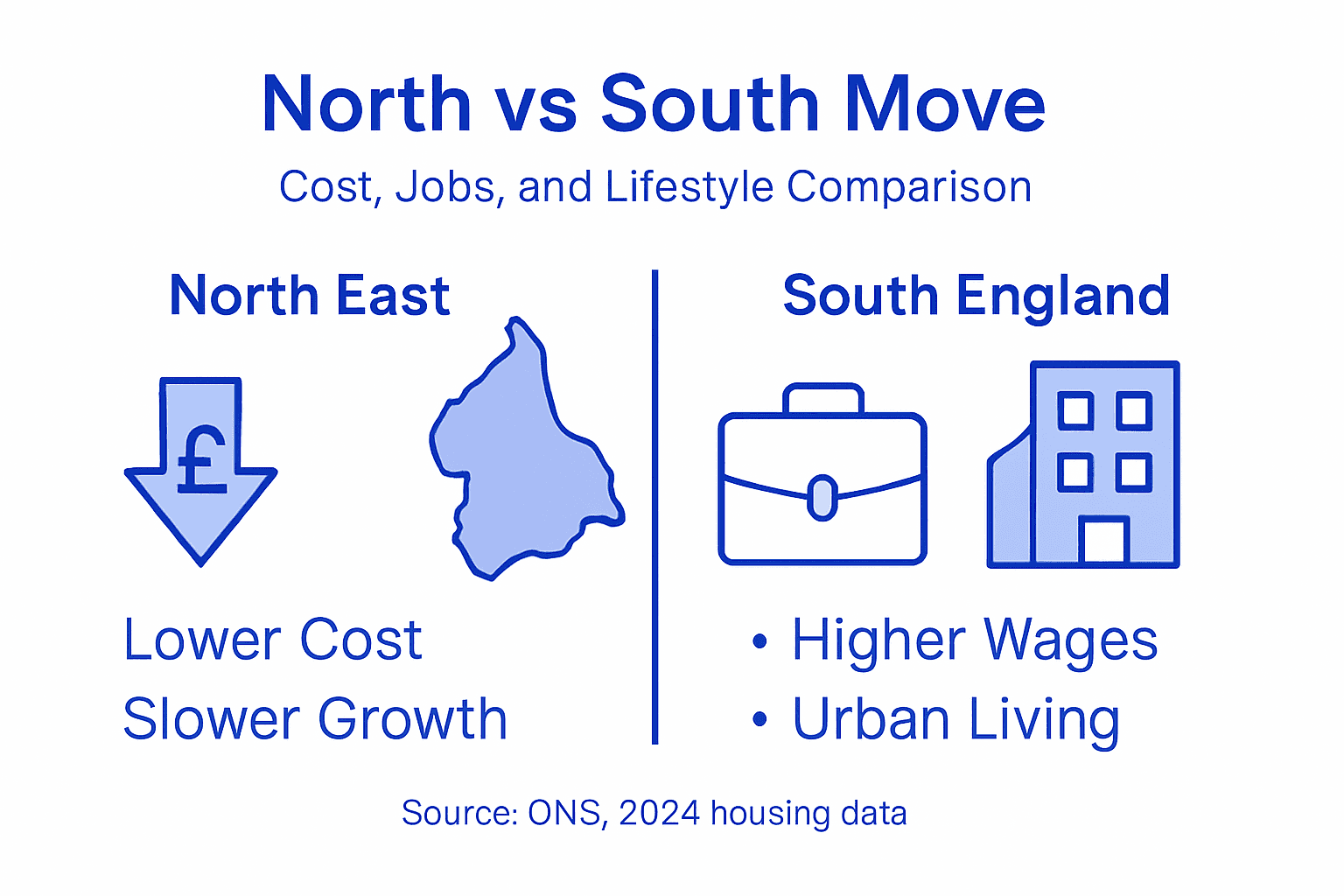
Below is a summary of current and emerging factors affecting relocation trends in the UK for 2026:
| Trend | Impact on Movers | Example Region |
|---|---|---|
| Remote work expansion | Enables flexible home location | County Durham |
| Regional investment | Increases local job opportunities | Northumberland |
| Digital infrastructure | Supports rural professional life | Rural Sussex |
| Demographic shifts | Alters community composition | Greater London area |
Pro tip: Research emerging regional development zones and upcoming infrastructure projects to identify potential relocation opportunities before they become mainstream market trends.
Choosing the Right Move: Risks and Tips
Moving between the North East and Southern regions of the United Kingdom demands careful strategic planning and comprehensive risk assessment. Relocation decision frameworks highlight the critical importance of understanding local economic conditions before making a significant geographical transition.
Key risk assessment considerations include:
- Local job market dynamics
- Cost of living variations
- Housing affordability
- Career progression opportunities
- Community integration potential
Devolution policy insights suggest that successful relocations require more than financial calculations. Professionals must evaluate broader factors like regional development initiatives, emerging economic zones, and potential long-term growth prospects in areas like County Durham and Northumberland.
Relocating involves navigating complex personal and professional landscapes. While Southern regions offer diverse job markets, Northern areas are increasingly developing innovative economic strategies that challenge traditional migration patterns. Understanding these nuanced dynamics allows individuals to make informed decisions that align with their personal and professional aspirations.
Pro tip: Conduct comprehensive research involving local economic reports, networking with professionals in your industry, and visiting potential locations to gain first-hand insights before finalising your relocation decision.
Make Your North East to South or South to North Move Effortless with Schott Removals
Relocating between the North East and Southern England involves weighing complex factors like housing affordability, job market shifts and lifestyle changes. If you are facing these challenges and want to ensure your move is seamless and stress-free, we can help. At Schott Removals, a trusted family-run company based in Darlington with over 30 years of experience, we specialise in tailored removals designed to suit your unique needs whether moving locally, nationally or internationally.
Don’t let the uncertainties of relocating across regions overwhelm you. Benefit from our expert local knowledge, reliable packing services and flexible storage solutions to protect what matters most. Explore our range of services in the Uncategorised Archives – Schott Removals and start planning your move today with confidence. Visit our main site Schott Removals now to get a personalised quote and take the first step toward your new beginning.
Frequently Asked Questions
What are the main differences in housing costs between the North East and South?
Housing costs in the North East are generally more affordable compared to the South, where property prices are significantly higher, particularly around urban centres.
How does the job market differ between the North East and South?
The job market in the South tends to be more diverse with higher salaries in sectors like financial services and technology, whereas the North East relies more on public sector jobs and manufacturing.
What lifestyle factors should I consider when relocating between regions?
Consider aspects such as community atmosphere, commuting patterns, and work-life balance, as the North East often offers a calmer lifestyle compared to the fast-paced environment in the South.
How does remote work affect relocation decisions?
The rise of remote work allows professionals greater flexibility in choosing their locations, making it possible to evaluate living in more affordable areas while still maintaining career opportunities.
Recommended
- When to Schedule Your Move: Essential Guidance for 2025 in the North East | Schott Removals
- Understanding Moving House in the North East: Why Local Knowledge Matters – Schott Removals
- Cost to Move House UK 2025: Guide for Homeowners and Businesses | Schott Removals
- Summer Moves in the North East – Which Towns By the Sea to Visit in 2025 – Schott Removals
- Brexit impact op verzending: Kosten en oplossingen – Send with Parcel International