
Every family preparing for a move from the North East of England to the United Kingdom quickly discovers that household goods import rules are far from straightforward. Whether you are bringing a beloved dining table or cherished keepsakes, understanding which items qualify as personal effects and what documentation is needed can help you avoid unnecessary stress, unexpected duties, or frustrating delays at the border. This guide breaks down the rules and provides practical solutions to make your international transition smoother and fully compliant.
Table of Contents
- Defining Household Goods Import Rules UK
- Types Of Goods And Special Categories
- Customs Procedures And Required Documentation
- Duties, Taxes And Exemptions Explained
- Common Mistakes And Compliance Risks
- Recent Changes Affecting Imported Goods
Key Takeaways
| Point | Details |
|---|---|
| Import Regulations | Understanding UK customs rules is essential for a smooth import process of household goods, particularly for items like furniture and electronics. |
| Documentation Requirements | Accurate and complete documentation, including an EORI number and detailed inventory, is critical to avoid delays and fines during customs clearance. |
| Duties and Exemptions | Familiarising oneself with customs duties and potential exemptions, such as Transfer of Residence relief, can lead to significant cost savings. |
| Compliance Risks | Avoid common mistakes by ensuring proper classification of goods and compliance with current regulations to prevent legal repercussions. |
Defining household goods import rules UK
Importing household goods into the United Kingdom involves navigating a complex set of customs regulations that determine what personal belongings can enter the country without incurring additional taxes or duties. These rules are crucial for individuals and families relocating internationally, particularly those moving from regions outside the European Union.
When importing household goods, the UK government has established clear guidelines about what constitutes personal effects and how they should be processed. Customs regulations for household moves typically cover items that are considered essential personal property, including:
- Furniture and home furnishings
- Personal clothing and accessories
- Electronic devices and appliances
- Kitchen equipment
- Personal hobby and recreational items
- Family heirlooms and personal memorabilia
The key considerations for importing household goods centre around several critical factors. First, individuals must understand their personal allowance, which determines the quantity and value of items that can be brought into the country without paying additional customs duties. These allowances vary depending on the origin of the goods and the traveller’s residency status.
Additionally, certain items are subject to specific restrictions or may require special declarations. UK customs information provides detailed guidance on banned or controlled items that might require additional processing or may be prohibited entirely.
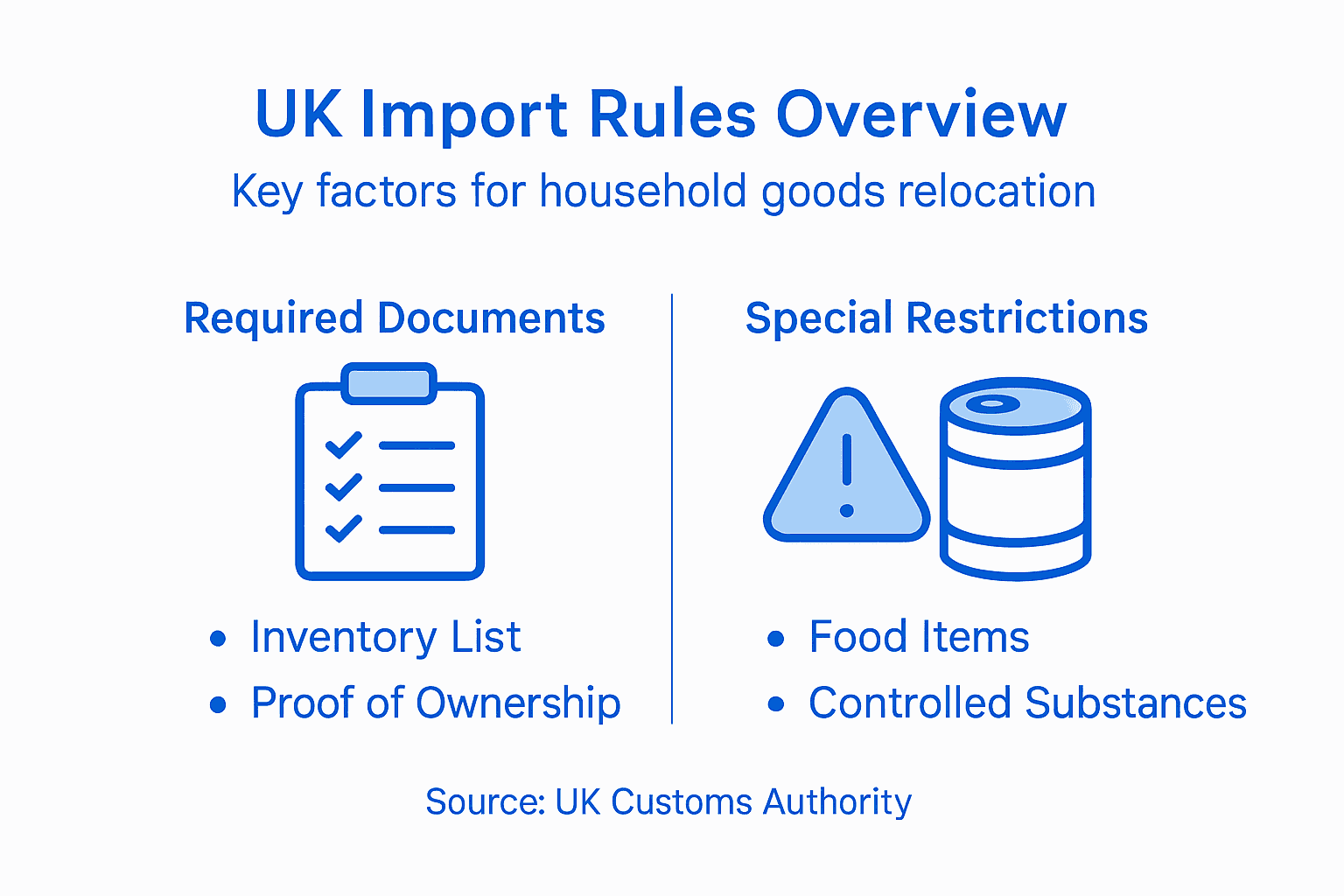
Pro tip: Always compile a comprehensive inventory of your household goods before international relocation, including estimated values and detailed descriptions to streamline the customs clearance process.
Types of goods and special categories
When importing household goods into the United Kingdom, not all items are treated equally. Different categories of goods are subject to unique regulations, restrictions, and potential customs scrutiny. Prohibited and restricted imports require careful consideration to ensure a smooth customs clearance process.
The main categories of goods with special import considerations include:
- High-risk food products
- Animal origin products
- Agricultural goods
- Electronic and technological equipment
- Controlled substances
- Cultural and heritage items
- Medical and pharmaceutical supplies
Specifically, food-related imports face stringent regulations. Food import regulations mandate comprehensive checks to ensure safety and compliance. High-risk food products must undergo extensive sanitary and phytosanitary inspections, with particular attention paid to items of animal origin, composite products, and potentially hazardous consumables.
Technological and electronic goods also require detailed documentation. Importers must provide proof of origin, safety certifications, and compliance with UK electromagnetic compatibility standards. Certain electronic devices might need additional permits or face restrictions based on their technological specifications or potential security implications.

Controlled substances represent another critical category with exceptionally strict regulations. Items such as pharmaceuticals, chemicals, and potentially dangerous materials require explicit permits, detailed declarations, and often specialised handling procedures during import.
Pro tip: Always consult official UK customs documentation and consider professional customs clearance advice when importing goods in complex or restricted categories to ensure full compliance and avoid potential legal complications.
Here is a summary of special import categories and their unique requirements:
| Category | Key Regulation | Additional Requirement | Potential Risk |
|---|---|---|---|
| Food and animal products | Sanitary/phytosanitary checks | Inspection certificates needed | Hazardous material seizure |
| Electronic equipment | Safety and EMC compliance | Safety certification, permits | Security concerns/penalties |
| Cultural/heritage items | Provenance and authenticity | Documentation of origin | Seizure or export restrictions |
| Controlled substances | Strict import permits | Explicit declaration | Legal penalties or prosecution |
| Medical/pharmaceuticals | Special handling protocols | Import licences | Confiscation or delay |
Customs procedures and required documentation
Navigating the customs procedures for importing household goods into the United Kingdom requires meticulous preparation and understanding of complex documentation requirements. Import goods into UK procedures demand careful attention to detail and comprehensive paperwork to ensure smooth customs clearance.
The essential documentation for household goods imports typically includes:
- Economic Operator Registration and Identification (EORI) number
- Detailed inventory of imported items
- Commercial invoice
- Proof of ownership
- Shipping manifests
- Certificate of origin
- Customs value declaration
Importers must first obtain an EORI number, which is crucial for tracking and declaring goods entering the United Kingdom. This unique identifier is mandatory for all individuals and businesses importing goods, serving as a critical component in the customs declaration process. The documentation must comprehensively list each item, including its estimated value, condition, and intended use.
Customs declarations require precise classification of goods using specific commodity codes. These codes determine the applicable customs duties and potential restrictions. Importers must provide accurate descriptions and values, as discrepancies can lead to delays, additional inspections, or potential financial penalties. Some household items may require additional specialised documentation, such as certificates of authenticity for valuable items or safety certifications for electronic equipment.
The financial aspects of importing household goods involve calculating and paying appropriate customs duties and Value Added Tax (VAT). Importers must be prepared to provide comprehensive financial documentation and potentially make upfront payments or provide guarantees for potential customs charges.
Pro tip: Create a comprehensive digital and physical file of all import documentation, keeping multiple certified copies and digital backups to expedite the customs clearance process and protect against potential administrative challenges.
Duties, taxes and exemptions explained
Understanding the complex landscape of customs duties, taxes, and exemptions is crucial for anyone importing household goods into the United Kingdom. Bringing goods into UK for personal use requires careful navigation of financial regulations and potential relief options.
The primary categories of duties and taxes for household goods imports include:
- Customs duty
- Value Added Tax (VAT)
- Transfer of Residence relief
- Personal allowance exemptions
- Temporary importation reliefs
- Commercial vs personal import distinctions
Customs duty is calculated based on the type and value of imported goods, with rates varying significantly depending on the item’s classification and origin. Most household goods are subject to standard import duties, which can range from 0% to substantial percentage rates depending on the specific item. VAT is typically charged at 20% on the total value of goods, including shipping and insurance costs, which can significantly increase the overall import expense.
The Transfer of Residence (ToR) relief offers a crucial exemption for individuals permanently relocating to the United Kingdom. This provision allows qualifying individuals to import household goods without paying customs duties and VAT, provided they meet specific criteria. To qualify, importers must demonstrate that they are establishing their primary residence in the UK and have owned and used the goods for a minimum period before relocation.
Personal allowances provide another potential avenue for reducing import costs. Individuals are permitted to bring a certain value of goods into the UK without incurring additional taxes, though these allowances can vary based on the mode of transportation and specific circumstances of the move. Careful documentation and understanding of these exemptions can result in substantial cost savings during the relocation process.
Pro tip: Maintain comprehensive records of ownership and usage for household goods, including purchase dates, original invoices, and photographic evidence, to substantiate potential exemption claims during customs assessment.
Below is a comparison of duty relief options for household goods imports:
| Relief Option | Main Criteria | Benefit Provided | Example Situation |
|---|---|---|---|
| Transfer of Residence (ToR) | Establishing UK primary residence | No duty or VAT on belongings | Moving permanently from abroad |
| Personal Allowance | Value/quantity within set thresholds | Tax-free import up to limit | Arriving with personal luggage |
| Temporary Importation | Non-permanent stay or use | Duties deferred until return | Goods brought for a short visit |
Common mistakes and compliance risks
Navigating the complexities of household goods importation requires understanding potential pitfalls that can lead to significant legal and financial consequences. Customs compliance guidelines highlight the critical importance of meticulous documentation and adherence to regulations.
The most prevalent compliance risks and common mistakes include:
- Incomplete or inaccurate customs declarations
- Undervaluing imported goods
- Failing to obtain necessary permits
- Importing prohibited or restricted items
- Incorrect classification of household goods
- Overlooking specific documentation requirements
- Misunderstanding personal allowance limits
Documentation errors represent the most frequent compliance challenge for individuals importing household goods. Importers often underestimate the complexity of customs declarations, leading to unintentional misrepresentations that can trigger significant penalties. Simple mistakes such as incorrect valuation, missing supporting documents, or incomplete item descriptions can result in immediate customs intervention, potential fines, or even goods seizure.
Potential consequences of non-compliance can be severe and far-reaching. Customs authorities may impose substantial financial penalties, ranging from moderate fines to amounts equivalent to the full value of imported goods. In more serious cases, repeated or deliberate non-compliance could lead to prosecution, travel restrictions, or permanent bans on importing goods into the United Kingdom.
Technological and regulatory changes further complicate the importation landscape. Importers must stay continuously informed about evolving customs regulations, which can change rapidly due to international trade agreements, Brexit-related adjustments, and ongoing policy modifications. Failing to keep abreast of these changes can inadvertently expose individuals to significant compliance risks.
Pro tip: Consult with a professional customs broker or relocation specialist before your move to conduct a comprehensive review of your household goods and ensure full compliance with current UK import regulations.
Recent changes affecting imported goods
The landscape of household goods importation into the United Kingdom has undergone significant transformations, particularly in the wake of Brexit and ongoing regulatory developments. Border controls for UK imports have introduced complex new requirements that dramatically impact how individuals and businesses manage international relocations.
Key recent changes affecting imported household goods include:
- Introduction of full customs declarations
- Phased border control implementations
- Changes in product marking requirements
- Updated sanitary and phytosanitary regulations
- New labelling and marketing standards
- Modification of import licensing procedures
- Transition from CE to UKCA marking
The post-Brexit regulatory environment has fundamentally restructured import procedures, with the Border Target Operating Model representing a pivotal shift in how goods enter the United Kingdom. Importers must now navigate more rigorous documentation requirements, including comprehensive customs declarations and increasingly detailed product information. These changes have significantly increased the administrative complexity of importing household goods.
Product standards and regulatory frameworks have also experienced substantial modifications. The transition from European CE marking to the UK-specific UKCA (United Kingdom Conformity Assessed) marking represents a critical change for many imported items. Manufacturers and importers must now ensure their household goods meet specific British standards, which may differ from previous European Union regulations.
Sanitary and phytosanitary controls have been progressively tightened, introducing more comprehensive checks on imported goods. These changes particularly impact items such as wooden furniture, textiles, and other household products that might pose potential biosecurity risks. Importers must now provide more extensive documentation and potentially undergo more rigorous inspection processes.
Pro tip: Maintain a flexible approach to importing household goods, regularly reviewing the latest UK customs guidelines and considering professional consultation to navigate the evolving regulatory landscape.
Simplify Your UK Household Goods Import with Expert Support
Importing household goods into the United Kingdom can be overwhelming due to detailed customs procedures, strict documentation requirements, and the need to comply with regulations like the Transfer of Residence relief and new post-Brexit rules. If you are facing challenges such as managing complex declarations, understanding duty exemptions, or ensuring compliance with sanitary checks and electronic equipment standards, you are not alone. These common pain points can lead to costly delays, penalties, or even seizure of your belongings.
Schott Removals specialises in making your international move seamless and stress-free. With over 30 years of experience handling European and international relocations, we understand the importance of precise documentation, accurate inventory management, and professional customs guidance. Our removal services and storage solutions are tailored to guide you through each step of your UK import journey, ensuring your household goods meet all regulatory standards and arrive safely.

Take control of your move today by partnering with a trusted family-run company that combines reliability and expertise. Visit Schott Removals for a personalised quote and discover how our professional team can help you avoid compliance risks while handling your household goods import smoothly. Start your journey now and experience relocation with confidence.
Frequently Asked Questions
What are the key household goods that can be imported without incurring customs duties?
Most household goods considered personal effects, such as furniture, clothing, electronics, and personal items, can be imported without incurring additional customs duties, provided they meet certain conditions and allowances.
What documentation is required when importing household goods into the UK?
Essential documentation includes an EORI number, an inventory of items, a commercial invoice, proof of ownership, shipping manifests, and customs value declarations to ensure smooth customs clearance.
How can I qualify for the Transfer of Residence relief when importing household goods?
To qualify for the Transfer of Residence relief, you must establish your primary residence in the UK and demonstrate that you have owned and used the goods for a minimum period prior to your relocation.
What are the common mistakes to avoid when importing household goods?
Common mistakes include submitting incomplete or inaccurate customs declarations, undervaluing goods, failing to obtain necessary permits, and misclassifying items, which can result in penalties or issues with customs clearance.