
Sorting through years of possessions can overwhelm even the most organised families preparing for a move. Whether your journey takes you from Newcastle to Manchester or across European borders, effective decluttering lays the groundwork for a smooth transition. By focusing on a room by room review, tracking your inventory with photographs, and carefully separating what to keep, donate, or discard, you set yourself up for a stress-free relocation and avoid last-minute chaos.
Table of Contents
- Step 1: Assess Your Belongings Room By Room
- Step 2: Sort And Categorise Items For Removal
- Step 3: Allocate Items To Keep, Sell, Or Donate
- Step 4: Pack And Label Essentials For Transport
- Step 5: Review Your Space To Confirm Decluttering
Quick Summary
| Key Point | Explanation |
|---|---|
| 1. Systematically sort belongings | Go room by room, categorising items into keep, donate, sell, and discard. |
| 2. Reduce total possessions | Aim to decrease your belongings by at least 30% for a smoother move. |
| 3. Photograph items for inventory | Take digital photos to track your items and simplify sorting as you pack. |
| 4. Evaluate donation options carefully | Research local charities to ensure items you can’t keep find suitable new homes. |
| 5. Conduct a final review of spaces | Walk through each room again to remove any last-minute clutter before packing. |
Step 1: Assess your belongings room by room
Moving requires a systematic approach to sorting through your possessions. Begin by creating a methodical plan that allows you to track your inventory and make informed decisions about what to keep, donate, or discard.
Start in one room and work methodically. In the bedroom, pull everything out of wardrobes and drawers. Sort clothing into clear categories: keep, donate, sell, and discard. For items with sentimental value, be ruthless yet kind to yourself. Ask whether each piece truly serves a purpose in your new home or if it is simply taking up valuable space. Kitchen items require similar scrutiny. Check expiration dates on food, assess your cookware, and consider whether you genuinely need multiple versions of the same item.

Approach each room with fresh eyes and a practical mindset. Consider the size of your new home and your lifestyle needs. Professional movers recommend reducing your total volume by at least 30% to make your move smoother and potentially less expensive.
Top tip: Take digital photographs of your belongings as you sort them to create a visual inventory and help you track your items during the move.
Step 2: Sort and categorise items for removal
Tackling the task of sorting your belongings requires a strategic approach. When preparing for a move, you need to classify different types of items with precision and care.
Begin by creating distinct piles for each category of items. Separate belongings into four primary groups: items to keep, donate, sell, and dispose of. Be especially careful with specialised items like electronics, hazardous materials, and bulky furniture. Some items require specific disposal methods. For instance, bulky waste collection has particular guidelines about what can and cannot be removed by local councils.
Consider the potential value and condition of each item. Furniture in good condition might be sold or donated, while damaged items should be responsibly discarded. Electronics often require special recycling procedures. For sentimental items, ask yourself if they truly enhance your life or simply occupy space. The goal is to streamline your possessions and make your upcoming move more manageable.
Here is a summary of recommended strategies for sorting and reducing belongings when moving:
| Strategy | Purpose | Example Action |
|---|---|---|
| Categorise items clearly | Avoid confusion during the move | Create keep, donate, sell, discard |
| Assess each item’s usefulness | Reduce unnecessary possessions | Question each item’s value |
| Photograph and document belongings | Keep track and simplify future sorting | Take photos for a digital list |
| Prioritise condition | Ensure items go to proper destination | Discard damaged objects |
| Factor in new home size | Prevent overcrowding and extra expenses | Measure available storage |
Top tip: Create a digital spreadsheet to track each item category, including estimated value and disposal method, to keep your sorting process organised and efficient.
Comparison of common removal and disposal methods:
| Method | Appropriate Items | Notes |
|---|---|---|
| Charity donation | Usable clothes, small items | Check charity guidelines |
| Online sale | Electronics, furniture | Use reputable platforms |
| Council collection | Large, bulky waste | Book in advance for pick-up |
| Special recycling | Hazardous or electronic waste | Locate proper local recycling centres |
Step 3: Allocate items to keep, sell, or donate
Deciding the fate of your personal belongings requires careful consideration and strategic thinking. Learn to evaluate donation options to ensure each item finds its most appropriate new home.
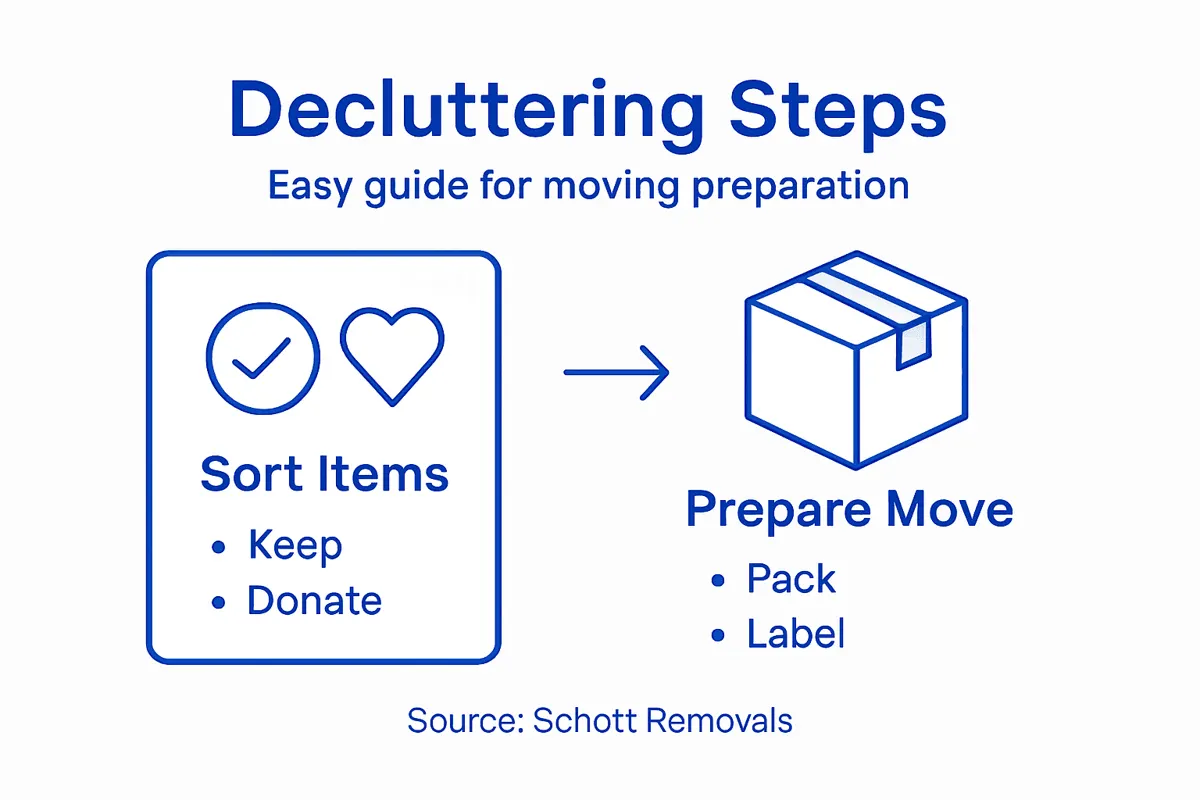
Start by creating three distinct zones in your sorting area. For items to keep, focus on practicality and genuine utility. Ask yourself whether each possession serves a meaningful purpose in your current lifestyle or future home. With items to sell, assess their condition and potential market value. Consider online marketplaces, local selling groups, or car boot sales for furniture and electronics in good condition. For donation, research local charities and organisations that might welcome specific items. Museums and collection centres often appreciate unique or historical pieces that might otherwise be discarded.
Be realistic and compassionate with your sorting. Some items might hold sentimental value but no practical use. Photograph these items if you struggle to part with them, creating a digital memory that takes up no physical space. Remember that letting go of possessions can be liberating and can help simplify your upcoming move.
Top tip: Create a digital inventory with photographs and descriptions of items you plan to sell or donate to streamline the allocation process and keep track of your belongings.
Step 4: Pack and label essentials for transport
Packing your belongings efficiently requires strategic planning and careful organisation. Learn essential packing techniques to ensure your items arrive safely and in perfect condition.
Start by gathering high-quality packing materials and sturdy boxes. Pack hard items first, using soft clothing or towels as protective padding between fragile objects. Create a systematic approach by packing room by room, keeping similar items together. Label each box clearly with its contents and destination room, using a permanent marker. Include special handling instructions for delicate items. Keep important documents, medication, and essential personal items in a separate carry-on bag that stays with you during the move. Safety and security declarations become crucial if you are moving across borders, so ensure all necessary documentation is prepared and accessible.
Consider the weight distribution in your boxes. Heavier items should be placed at the bottom, with lighter items on top to prevent crushing and damage. Use colour-coded labels or numbered systems to track your boxes easily, which can be particularly helpful for complex moves or when using professional removal services.
Top tip: Take photographs of valuable or fragile items before packing as a personal record and potential insurance documentation.
Step 5: Review your space to confirm decluttering
After your initial decluttering efforts, a thorough final review becomes crucial to ensure you have successfully streamlined your belongings. Systematic space evaluation will help you confirm that your decluttering process has been comprehensive and effective.
Begin by walking through each room systematically, examining every surface and storage area. Look critically at each remaining item and ask yourself whether it truly adds value to your life or will serve a purpose in your new home. Remove any final items that do not meet this criteria. Pay special attention to hidden spaces like cupboards, drawers, and shelves where unnecessary items often accumulate. Cleaning tips for thorough inspection can help you identify overlooked clutter and ensure your space is completely prepared for moving.
Take time to create a visual record of your newly decluttered spaces. Photograph each room from multiple angles to document your progress and provide a sense of accomplishment. This visual evidence will also serve as a useful reference point during packing and moving, helping you maintain the organised approach you have worked hard to achieve.
Top tip: Use a digital checklist on your smartphone to systematically track your review process, ensuring you do not miss any areas during your final decluttering sweep.
Simplify Your Move with Expert Help from Schott Removals
Decluttering before moving can feel overwhelming with all the sorting, packing, and decisions to make. The key challenge is staying organised while reducing your possessions efficiently to avoid stress and high costs. From categorising your belongings to labelling boxes for transport, every step requires care and precision to protect your valuable items and prepare your new home space. If you want peace of mind knowing your carefully sorted and packed items are handled professionally, Schott Removals is here to help.
Take the hassle out of your move by working with an experienced, family-run company with over 30 years in the industry. Whether you need local house removals, national relocation services, or secure storage solutions, we provide reliable, tailored support every step of the way. Visit our Uncategorised Archives – Schott Removals to learn more about how we make moving straightforward. Ready to make your move stress free and efficient Visit Schott Removals today and get started with a free online quote.
Frequently Asked Questions
What is the best way to start decluttering before moving?
Begin your decluttering process by assessing your belongings room by room. Pull everything out and sort items into categories: keep, donate, sell, and discard. This targeted approach helps you focus on one space at a time and can significantly reduce your total volume by at least 30%.
How can I decide which items to keep, sell, or donate?
Evaluate each item based on its usefulness and condition. Create three distinct zones for items you wish to keep, sell, or donate, and be honest about whether each item enhances your life. For items with sentimental value, consider taking photographs to preserve the memory while freeing up space.
What should I do with items that require special disposal, like electronics?
For specialised items like electronics, check local recycling options to ensure responsible disposal. Many councils have specific guidelines for hazardous waste, so verify what can be collected and follow their procedures to avoid improper disposal.
How can I organise my packing for the move?
Organise your packing by gathering sturdy boxes and high-quality packing materials. Pack room by room, labelling each box clearly with its contents and destination room, and keep delicate items safe with soft materials like clothing or towels as padding.
How do I ensure I have thoroughly decluttered before moving?
Conduct a final walk-through in each room, examining hidden spaces such as cupboards and drawers. This systematic evaluation will help you identify any remaining unnecessary items to remove, ensuring that your new space remains clutter-free and organised for your move.
Recommended
- Stress-Free Moving Checklist 2025: UK, International & Business Moves | Schott Removals
- What to Expect on Moving Day in the UK: Key Steps in 2025 | Schott Removals
- House Removal Process Explained: Step-by-Step Guide for 2025 | Schott Removals
- Managing Moving Day Logistics: Expert Tips for UK Moves 2025 | Schott Removals
- 7 ventajas del minimalismo en belleza para tu bienestar diario – Cosmetics Niche