
Many assume standard storage units work fine for business needs, but specialised business storage offers security, insurance, and flexibility that personal storage simply can’t match. This guide reveals what business storage truly delivers for UK families moving house and small businesses managing transitions.
Table of Contents
- Introduction To Business Storage
- Key Features And Security Of Business Storage
- Cost Structures And Pricing Models For Business Storage In The UK
- Business Storage Vs. Personal Storage: What’s The Difference?
- Common Misconceptions About Business Storage
- Practical Applications And How To Choose The Right Business Storage
- Conclusion: Leveraging Business Storage For A Smooth Transition
- Secure Your Business Storage Solutions With Schott Removals
- Frequently Asked Questions
Key takeaways
| Point | Details |
|---|---|
| Business storage provides specialised secure solutions for UK small businesses and moving households with enhanced security and insurance options compared to personal storage. | Facilities offer CCTV monitoring, controlled access, and comprehensive asset protection tailored to valuable business inventory and equipment. |
| Pricing varies by unit size, location, and contract length but remains cost-effective when balanced against security features and operational continuity benefits. | Typical costs range from £15-£50 weekly depending on space requirements, with additional insurance available for high-value items. |
| Choosing the right storage requires assessing your specific needs, reviewing contract terms carefully, and verifying provider security certifications. | Consider volume, access frequency, and item types before committing to ensure the solution matches your transition requirements. |
| Common misconceptions about excessive costs and inflexibility often deter users from exploring business storage when it could be their ideal solution. | Understanding the real differences between business and personal storage helps you make informed decisions that protect assets effectively. |
Introduction to business storage
Business storage refers to secure, flexible facilities designed specifically to house business assets, inventory, equipment, and documents during transitions or when additional space is required. Unlike personal storage, these facilities cater to commercial needs with enhanced security protocols, insurance options, and access arrangements that support ongoing business operations. For UK families managing house moves or renovations, business storage provides the same robust protection for valuable household items that require extra care.
The primary distinction lies in security sophistication and contractual flexibility. Business storage facilities implement commercial-grade security systems including monitored CCTV, alarm systems, and restricted access controls that protect high-value assets. Personal storage typically offers basic security suitable for general household items but lacks the comprehensive protection business inventory demands.
Typical UK use cases demonstrate the versatility of business storage solutions:
- Small businesses storing excess inventory during office relocations or seasonal fluctuations
- Families protecting valuable furniture and belongings during home renovations or downsizing
- Retailers managing overflow stock without committing to expensive warehouse leases
- Professional services firms archiving important documents whilst maintaining compliance requirements
The benefits extend beyond simple space provision. Business storage maintains operational continuity by ensuring inventory remains accessible when you need it, protects assets from damage or theft through advanced security measures, and offers scalable solutions that grow or shrink with your requirements. For families mid-move, this means your belongings stay safe and accessible without cluttering temporary accommodation or risking damage in unsuitable spaces.
Key features and security of business storage
Security features distinguish business storage from basic alternatives, providing peace of mind that your assets remain protected around the clock. Modern facilities employ multiple security layers that work together to prevent unauthorised access and detect potential threats immediately.

CCTV surveillance covers all entry points, corridors, and unit access areas with 24/7 recording and monitoring. Many facilities employ security personnel who respond to alerts and conduct regular patrols. Controlled access systems require unique codes or biometric authentication, creating detailed logs of who enters the facility and when. Perimeter security including fencing, lighting, and alarm systems adds another barrier against intrusion.
Insurance represents a critical consideration when storing valuable business assets or cherished family possessions. Most business storage providers include basic insurance coverage in their contracts, but limits vary significantly. Basic policies might cover £1,000-£5,000 per unit, which proves insufficient for expensive equipment or extensive inventory. Purchasing additional insurance ensures adequate protection proportional to your asset value.
Technological innovations enhance security whilst improving convenience. Remote monitoring allows you to check facility status via mobile apps, electronic access control eliminates physical keys that can be lost or copied, and environmental monitoring alerts you to temperature or humidity changes that might damage sensitive items. Some facilities offer secure cabinet storage within larger units for particularly valuable or confidential materials.
Pro Tip: Before signing any contract, verify the facility holds relevant security certifications and review insurance terms carefully. Ask specifically about coverage limits, excess payments, and whether your business insurance extends to stored items.
These security features dramatically reduce risk compared to personal storage options. Business storage facilities understand that operational disruption from theft or damage costs far more than the items themselves, so they invest heavily in prevention and rapid response capabilities.
Cost structures and pricing models for business storage in the UK
Understanding pricing structures helps you budget accurately and compare providers effectively. Business storage costs vary based on several factors, but transparency around these variables enables informed decisions that balance security with affordability.
Unit size represents the primary cost driver. Small units suitable for document storage or limited inventory typically cost £15-£25 weekly, medium units accommodating office furniture and equipment range from £25-£40 weekly, whilst large units for substantial inventory or complete office contents reach £40-£60 weekly. Urban locations near city centres command premium prices compared to suburban or rural facilities due to property costs and demand.
Contract length significantly impacts pricing. Month-to-month arrangements offer maximum flexibility but cost 20-30% more than six or twelve month commitments. However, longer contracts reduce your ability to respond quickly to changing needs. Efficient scheduling of storage needs helps you determine the optimal contract length based on your transition timeline.
| Cost factor | Impact on price | Typical range |
|---|---|---|
| Unit size | Primary driver | £15-£60 weekly |
| Location | 15-30% variance | Urban premium vs suburban savings |
| Contract length | 20-30% savings for long-term | Month-to-month vs annual commitment |
| Insurance | Variable add-on | £5-£20 monthly per £10,000 covered |
| Access hours | 10-15% premium | Standard vs 24/7 access |
Additional costs often catch users unprepared. Insurance premiums beyond basic coverage add £5-£20 monthly per £10,000 of asset value. Administration fees for contract setup or amendments typically range from £20-£50. Some facilities charge for amenities like trolley use, parking, or enhanced climate control.
The role of cost scheduling tools becomes apparent when managing storage expenses alongside moving costs. Tracking all expenditure ensures you stay within budget whilst obtaining necessary services.
Pro Tip: Never select storage based solely on the lowest price. Inadequate security or restrictive access policies create hidden costs through damaged goods, operational delays, or emergency relocations to better facilities. Balance price with service quality and security features to achieve genuine value.
Business storage vs. personal storage: what’s the difference?
Choosing between business and personal storage requires understanding fundamental differences that extend beyond marketing labels. These distinctions affect security, access, contracts, and ultimately whether the solution meets your specific requirements.
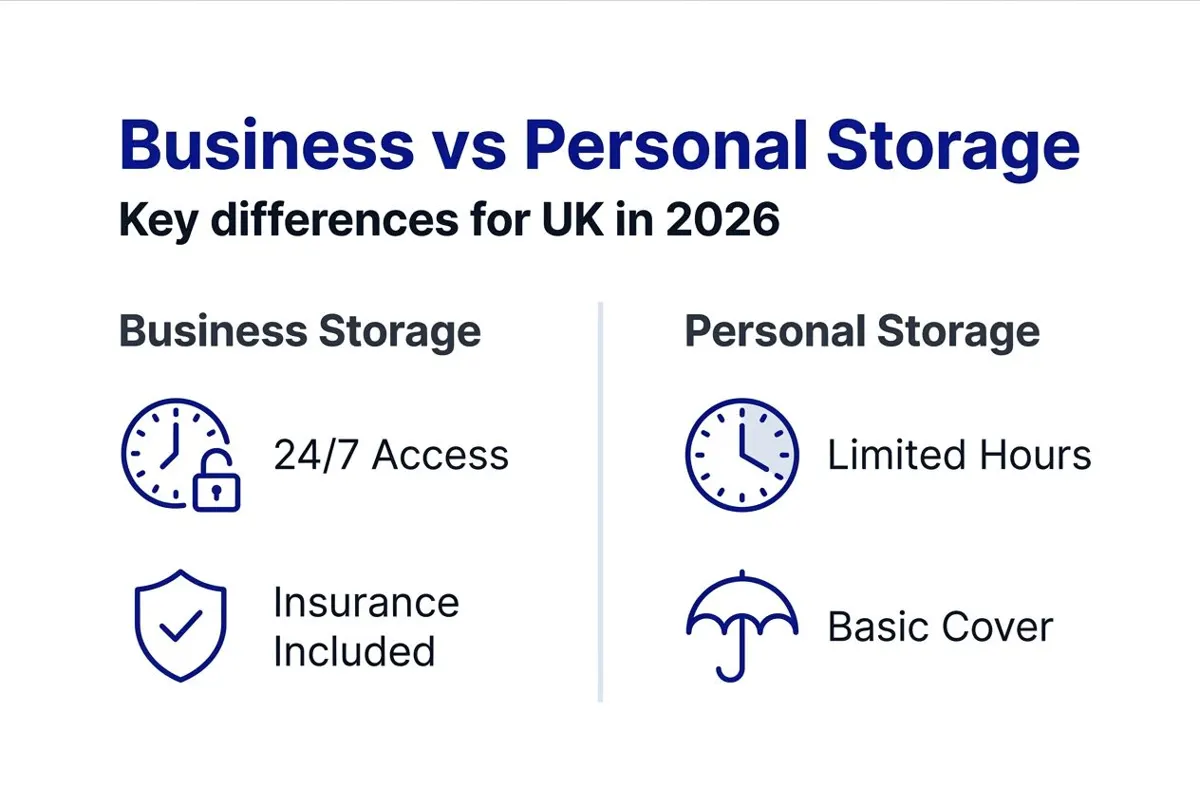
Security sophistication separates the two categories most noticeably. Business storage facilities implement commercial-grade systems with monitored CCTV, alarm systems, and controlled access creating detailed audit trails. Personal storage often relies on padlocks and basic perimeter security suitable for household items but inadequate for valuable business assets or items requiring insurance claims documentation.
Access policies reflect different user needs. Business storage typically offers extended or 24/7 access recognising that you might need inventory outside traditional hours. Personal storage often restricts access to standard business hours, which proves inconvenient when you need items urgently during a move or renovation.
Contractual terms and management services differ substantially. Business storage contracts accommodate commercial requirements including multiple authorised users, detailed inventory tracking, and receipt/dispatch services for ongoing operations. Personal storage contracts assume single-user access and static storage without ongoing activity.
| Feature | Business storage | Personal storage |
|---|---|---|
| Security level | Commercial-grade with monitoring | Basic perimeter and padlocks |
| Access hours | Extended or 24/7 available | Standard business hours typically |
| Insurance options | Comprehensive with high limits | Basic coverage with low limits |
| Contract flexibility | Multiple users, inventory services | Single user, static storage |
| Compliance support | Document retention, audit trails | Not typically offered |
| Average cost | £25-£60 weekly | £15-£35 weekly |
Legal and compliance requirements often mandate business storage for certain industries. Professional services firms must maintain client records securely with access logs, retailers need insurance documentation for inventory claims, and regulated businesses require environmental controls for sensitive materials. Personal storage rarely meets these compliance standards.
Business storage becomes necessary when you store items exceeding personal storage insurance limits, require frequent access outside standard hours, need multiple people accessing the facility, or must maintain compliance with industry regulations. For families with valuable antiques, art collections, or extensive possessions during extended moves, business storage provides superior protection justifying the modest cost premium.
Common misconceptions about business storage
Misunderstandings about business storage prevent many potential users from exploring solutions that perfectly match their needs. Addressing these misconceptions helps you evaluate options objectively based on facts rather than assumptions.
Myth: Personal storage suffices for business needs. Many assume basic storage units adequately protect business assets, but inadequate security and insurance create significant risks. When theft or damage occurs, personal storage insurance limits rarely cover actual losses, and lack of access logs complicates insurance claims. Business storage provides documentation and protection that personal alternatives simply cannot match.
Myth: Business storage always costs substantially more. Whilst business storage does command a premium, the difference typically amounts to 20-30% rather than the doubling many expect. When factoring in enhanced insurance, superior security, and flexible access preventing operational disruptions, business storage often delivers better value than cheaper alternatives requiring additional insurance purchases and inconvenient access restrictions.
Myth: Security differences are minimal. This dangerous assumption leads businesses to store valuable inventory in facilities lacking adequate protection. Business storage facilities invest heavily in multi-layered security systems, professional monitoring, and rapid response capabilities. Personal storage relies primarily on physical locks that determined thieves easily defeat. The security gap is substantial and consequential.
Myth: Contracts are inflexible or overly complex. Modern business storage providers recognise that flexibility attracts and retains clients. Most offer rolling monthly contracts after initial minimum periods, allow unit size changes, and provide straightforward terms without hidden clauses. Complexity fears often stem from comparing outdated warehouse leases rather than contemporary storage solutions.
These misconceptions cause poor storage choices manifesting as inadequate insurance coverage, security breaches, access frustrations, and ultimately emergency relocations to appropriate facilities. Understanding reality versus perception enables confident decisions that protect your assets and support smooth transitions whether you’re moving house, managing renovations, or navigating business changes.
Practical applications and how to choose the right business storage
Selecting appropriate business storage requires systematic assessment of your needs followed by careful provider evaluation against specific criteria. This methodical approach ensures you obtain suitable solutions without overpaying for unnecessary features or compromising on essential requirements.
Follow these steps to assess your storage requirements:
- Calculate volume by inventorying all items requiring storage with measurements for furniture and equipment plus box counts for smaller items
- Determine access frequency considering how often you’ll need stored items and whether requirements fall within standard hours or demand extended access
- Identify special requirements such as climate control for sensitive materials, power supply for equipment, or enhanced security for high-value items
- Establish timeline by defining storage duration from minimum to maximum likely periods to guide contract selection
- Set realistic budget accounting for rental costs, insurance, transport, and potential additional fees
Key criteria for selecting providers ensure you compare like-with-like across options:
- Security features including CCTV coverage, access controls, monitoring services, and physical barriers
- Insurance offerings covering included limits, additional coverage costs, excess payments, and claims processes
- Contract terms specifying minimum periods, notice requirements, price increase policies, and flexibility provisions
- Location convenience balancing accessibility for regular visits against cost savings from more distant facilities
- Facility condition reflecting maintenance standards, cleanliness, and environmental controls
- Customer reviews revealing service quality, responsiveness, and problem resolution capabilities
Organising stored inventory maximises efficiency and protects items during storage. Label all boxes clearly with contents and priority levels, create digital inventory lists with photos, position frequently needed items near unit entrances, and use eco-friendly storage solutions where possible to reduce environmental impact. Planning efficient scheduling for storage access prevents wasted trips and ensures you retrieve items when genuinely needed.
Pro Tip: Always confirm cancellation policies and flexible access hours before signing contracts. Business circumstances change unexpectedly, and restrictive terms create problems when you need to respond quickly to new situations. Providers confident in their service offer reasonable exit terms without penalty clauses.
Consider environmental factors in your selection. Facilities implementing renewable energy, recycling programmes, and sustainable building practices demonstrate corporate responsibility whilst often providing better-maintained premises. These considerations matter increasingly to customers and reflect operational quality standards.
Conclusion: leveraging business storage for a smooth transition
Business storage delivers security, flexibility, and cost-effectiveness that transforms challenging transitions into manageable processes. Whether you’re relocating your business, moving house, or managing renovations, appropriate storage solutions protect valuable assets whilst maintaining accessibility for ongoing needs.
The security advantages alone justify consideration. Commercial-grade monitoring, comprehensive insurance options, and controlled access systems provide protection that personal storage alternatives cannot match. For families with valuable possessions or businesses with critical inventory, this protection prevents losses that far exceed storage costs.
Flexibility supports changing circumstances throughout your transition. Scalable solutions accommodate fluctuating requirements, extended access hours enable retrieval when needed, and straightforward contracts allow adjustments without penalty. This adaptability reduces stress during already demanding periods.
Planning storage solutions proactively rather than reactively ensures smooth transitions. Assessing needs early, comparing providers carefully, and securing appropriate facilities before urgent requirements arise prevents rushed decisions that compromise security or cost more through emergency arrangements. Business storage represents an investment in continuity and peace of mind that supports successful outcomes.
Secure your business storage solutions with Schott Removals
Schott Removals offers secure, flexible business storage solutions tailored specifically to UK moving and transition needs. With over 30 years of experience supporting families and businesses throughout the relocation process, we understand that appropriate storage makes the difference between stressful disruption and smooth transitions.
Our facilities provide comprehensive security, flexible access arrangements, and insurance options that protect your valuable possessions throughout their storage period. We also supply quality packing materials ensuring your items remain in perfect condition whether stored short or long term.
Explore our expert business moving guidance for additional insights supporting successful relocations. Visit Schott Removals to discuss your storage requirements with our experienced team and receive a personalised quote matching your specific needs.
Frequently asked questions
What items are typically stored in business storage?
Business storage commonly houses office furniture, computer equipment, inventory, archived documents, seasonal stock, and valuable assets requiring secure protection. The facilities accommodate both short term storage during transitions and long term requirements for items needed infrequently.
Can I access my business storage outside normal working hours?
Many business storage providers offer 24/7 or extended access hours with secure electronic controls recording all entries. Access arrangements depend on your chosen facility and contract terms, so confirm requirements before committing to ensure the provider accommodates your schedule.
Is insurance included with business storage?
Basic insurance coverage is typically included in business storage contracts, but limits often range from £1,000 to £5,000 per unit. Additional insurance can be purchased for higher value assets, with premiums calculated based on declared item values and typically costing £5 to £20 monthly per £10,000 covered.
How do I choose the right sized business storage unit?
Assess your storage volume by creating a detailed inventory of items with measurements for large pieces and box counts for smaller items. Most providers offer online size calculators and consultation services helping you select appropriate units, and many allow size changes if initial estimates prove inaccurate.
Recommended
- DeWALT Dcs356 Foam Inserts DEWALT ToughSystem 2.0 Deep Compact Organiser 10 1/4" X 14 1 Dewalt Toughsystem 2.0 Organizer Central Bin Storage Dewalt Dwst8334 1