
Moving offices sounds simple at first glance. Just pack everything up and ship it across town, right? Yet technological migrations can add up to 40 percent more time to an office move if not carefully managed. Most are surprised to learn that it is not the desks or the distance that drag things out, but rather all those hidden layers of digital infrastructure and intricate planning underneath.
| Takeaway | Explanation |
|---|---|
| Plan thoroughly for office moves | Comprehensive planning reduces potential downtime and streamlines the relocation process. |
| Understand the scope of the move | The size and complexity of your office dictate the necessary timelines and logistical considerations. |
| Engage professional moving experts | Experienced movers can minimise risks and enhance efficiency during the relocation process. |
| Prepare for technological transitions | Ensure meticulous planning for network reconfigurations and data migrations to avoid extended delays. |
| Communicate effectively with staff | Transparent timelines help alleviate employee anxiety, maintaining morale during transitions. |
Understanding how long office moves take involves navigating multiple complex variables that significantly impact overall relocation timelines. The duration of an office move is not a uniform experience but a nuanced process influenced by various interconnected elements that require strategic planning and professional expertise.
The size and complexity of an office move fundamentally dictate its duration. A small consultancy firm relocating within Darlington might complete their move in a single day, whereas a large corporate enterprise with multiple departments and extensive technological infrastructure could require several weeks of meticulous planning and execution. Key considerations include:
Companies must carefully assess their specific requirements and anticipate potential challenges that could extend moving timelines.
Our comprehensive office removals process guide provides deeper insights into managing these intricate logistical considerations.
Professional office relocations demand extensive preparation that significantly influences overall move duration. Businesses must account for critical preparatory stages such as inventory management, equipment dismantling, secure packing of sensitive documents, and coordinating technological infrastructure transfers. According to research from the British Chambers of Commerce, comprehensive planning can reduce potential downtime by up to 40%.
The preparatory phase typically involves:
Selecting an experienced removal company specialising in office relocations dramatically impacts move efficiency. Professional movers with specific expertise in commercial relocations can streamline processes, reduce potential risks, and significantly compress moving timelines. Factors such as specialised equipment, trained personnel, and strategic planning contribute to faster, more seamless office moves.
Businesses in the North East, particularly those based in Darlington and County Durham, benefit from partnering with local removal experts who understand regional logistical nuances and can provide tailored, efficient moving solutions.
Understanding the intricacies of moving timeframes is not merely an administrative task but a critical strategic process that can significantly impact business operations, financial planning, and organisational productivity. Companies that invest time in comprehending the nuanced dynamics of relocation timelines position themselves to minimise disruption and maximise operational efficiency.
Precise moving timeframes represent a fundamental aspect of financial and operational risk management. Unexpected delays or extended moving periods can translate into substantial economic consequences for businesses. Unplanned downtime can result in significant revenue losses and potentially damage client relationships. According to research from McKinsey, organisations that develop comprehensive moving strategies can reduce potential financial risks by up to 35%.
Key financial considerations include:
Careful timeframe understanding enables businesses to develop robust business continuity strategies. Professional organisations recognise that moving is not just a logistical exercise but a complex operational transition requiring meticulous planning. Our guide on moving timelines provides deeper insights into strategic planning approaches.
Businesses must consider:
Moving timeframes directly influence employee experience and organisational morale. Transparent, well-communicated moving schedules help reduce uncertainty and anxiety among staff members. Employees who understand the moving process and its expected duration are more likely to remain engaged and supportive during organisational transitions.
In regions like the North East, particularly in business communities around Darlington and County Durham, understanding moving timeframes reflects a professional approach to change management. Companies that communicate effectively and plan strategically demonstrate their commitment to employee welfare and organisational stability.
Office relocations are not uniform experiences, and the type of move fundamentally determines its complexity, timeline, and required resources. Understanding the nuanced variations between different moving scenarios helps businesses develop precise expectations and strategic planning approaches tailored to their specific circumstances.
The geographical scope of an office move dramatically influences its duration and logistical requirements. Local moves within a concentrated area like Darlington or County Durham typically involve shorter timelines and less complex planning. According to research from the British Business Relocation Association, local moves can often be completed within 1-3 days, depending on office size.
Key distinctions between local and long-distance moves include:
Long-distance relocations, particularly those spanning multiple regions or involving international transitions, require significantly more comprehensive planning and extended timelines.
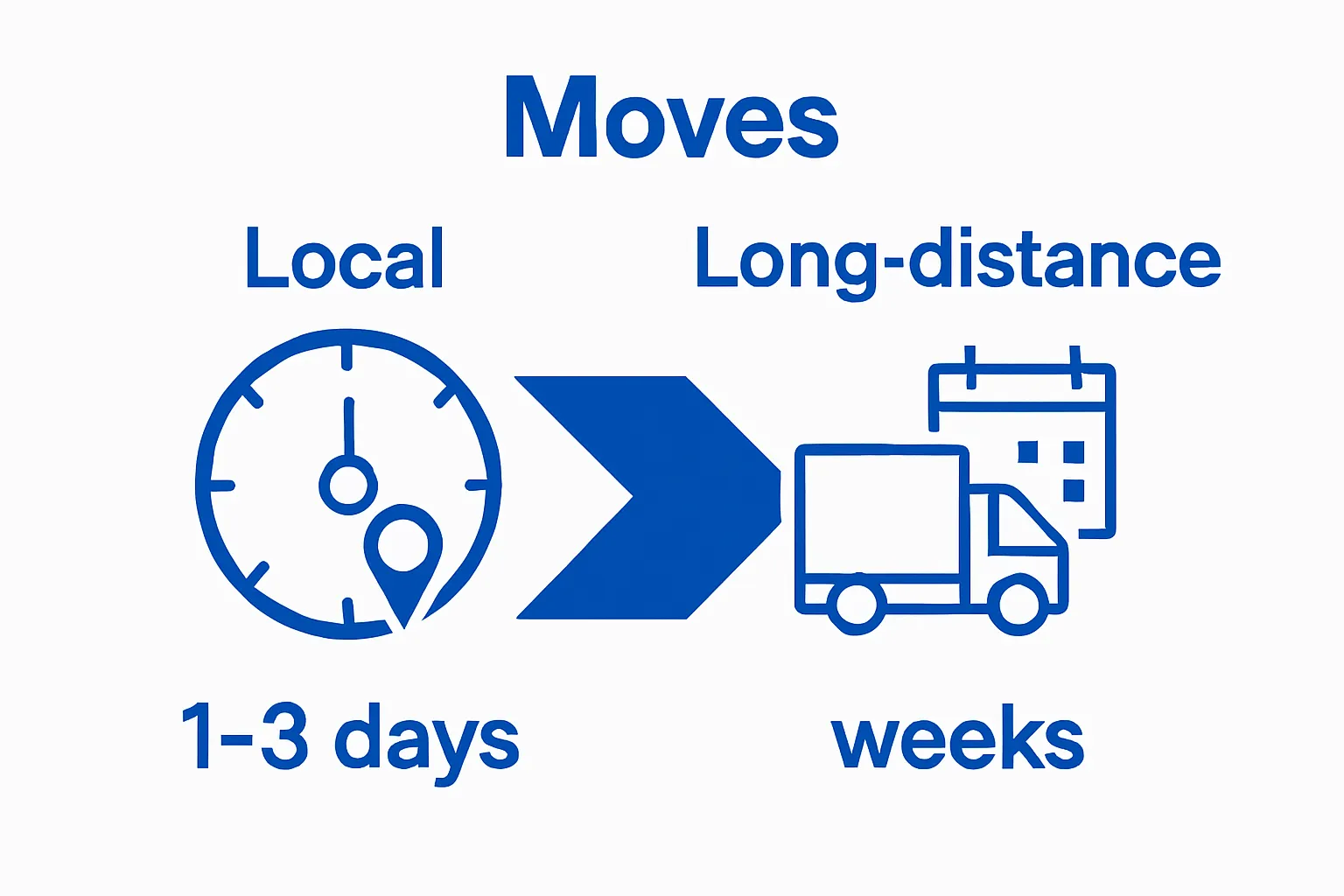 These moves might necessitate weeks of preparation and multiple-stage implementation strategies.
The scale of an organisation fundamentally transforms the moving experience. Small businesses typically experience more agile and rapid relocation processes, whereas large enterprises require intricate, multiphased moving strategies. Our comprehensive office removals guide provides detailed insights into managing moves of varying complexities.
Considerations for different organisational scales include:
Certain industries and businesses require highly specialised moving approaches that extend traditional relocation timelines. Sectors such as medical research, technology firms, and organisations with sensitive equipment demand meticulous planning and potentially longer transition periods.
Specialised moves might involve:
Businesses in the North East, particularly those in advanced technological or research-driven sectors around Darlington and County Durham, must develop nuanced moving strategies that account for their unique operational requirements.
The following table provides a clear comparison of the different types of office moves discussed in the article, highlighting how each affects the duration and complexity of the relocation process.
| Type of Office Move | Typical Duration | Complexity Level | Key Challenges |
|---|---|---|---|
| Local Relocation | 1-3 days | Lower | Shorter travel, immediate setup, minimal storage |
| Long-Distance Relocation | Weeks (may vary) | Higher | Complex logistics, storage needs, regulatory issues |
| Small Business Move | Rapid (often < 1 week) | Lower | Fewer assets, limited IT, agile processes |
| Enterprise-Level Move | Several weeks | High | Multiphasic, complex IT and data, regulatory burden |
| Standard Office Relocation | Faster setup | Moderate | Routine assets and technology, standard processes |
| Specialised Office Relocation | Extended timelines | Very High | Sensitive equipment, custom security, strict protocols |
Office relocations frequently encounter unexpected obstacles that can dramatically elongate moving timelines, transforming what seems like a straightforward process into a complex logistical challenge. Understanding these potential roadblocks enables businesses to develop proactive strategies and mitigate potential disruptions.
Technological migration represents one of the most significant challenges in modern office relocations. Businesses increasingly rely on intricate digital ecosystems that cannot simply be unplugged and reconnected. Servers, network infrastructure, specialised computing systems, and integrated communication platforms require meticulous planning and execution. Our detailed moving day guidance highlights the critical nature of technological transitions.
Key technological challenges include:
According to research from Gartner, technological migrations can extend moving timelines by up to 40% if not carefully orchestrated.
Organisations operating in regulated industries face additional complexity during office relocations. Sectors such as finance, healthcare, and technology must navigate stringent compliance requirements that can significantly impact moving schedules. Businesses in the North East, particularly those in Darlington and County Durham, must ensure their relocations meet specific regional and industry-specific regulations.
Critical compliance factors include:
Coordinating multiple operational elements represents another substantial challenge in extending move times. Successful relocations require precise synchronisation between various departments, external vendors, and internal stakeholders. Miscommunication or lack of comprehensive planning can result in cascading delays.
Potential synchronisation challenges encompass:
Businesses that invest in robust communication strategies and develop comprehensive moving plans can significantly reduce potential timeline extensions and operational disruptions.
This table summarises common challenges that can extend the timeline of an office move, organising them by challenge type and the specific factors involved.
| Challenge Type | Description | Key Factors Impacting Duration |
|---|---|---|
| Technological Infrastructure | Complex IT, networks, and digital migration | Data security, compatibility, test cycles, downtime |
| Regulatory & Compliance | Industry-specific standards and legal obligations | Data protection, documentation, sector regulations |
| Logistical & Operational Sync | Aligning people, vendors, and schedules | Multi-team coordination, asset tracking, communications |
Planning and preparation are the foundational elements that can dramatically compress or extend office relocation timelines. A strategic, systematic approach transforms what could be a chaotic transition into a streamlined, efficient process. Professional businesses recognise that meticulous preparation is not an optional extra but a critical component of successful office moves.
Detailed inventory management represents the cornerstone of efficient office relocations. Businesses must develop a granular understanding of their physical and digital assets before initiating any moving process. Our expert moving day logistics guide provides comprehensive insights into systematic asset tracking.
Key inventory preparation strategies include:
According to research from PwC, organisations that invest in thorough inventory management can reduce relocation timelines by up to 30%.
Successful office moves require sophisticated timeline engineering and intelligent resource allocation. Businesses must develop phased moving strategies that minimise operational disruption while ensuring comprehensive transition management. This approach demands careful sequencing of activities and precise coordination across multiple departments.
Critical timeline management considerations include:
Modern office relocations are fundamentally technological transitions. Preparing communication and technological infrastructure represents a complex but crucial preparation stage. Businesses must develop comprehensive migration strategies that ensure minimal downtime and seamless system transitions.
Technological preparation strategies encompass:
Businesses in the North East, particularly those in Darlington and County Durham, can significantly optimise their moving processes by adopting these strategic preparation approaches. Proactive planning transforms relocation from a potential organisational challenge into a structured, manageable transition.

Wondering how to avoid costly delays and hidden headaches during your next office move? The questions raised in our article reveal just how vital expert planning, risk management and seamless communication really are. Many businesses in Darlington and beyond worry about extended downtime, technical disruptions and the stress of keeping the team informed. These concerns can threaten productivity and impact your bottom line if not addressed by professionals with proven experience.
Choose Schott Removals for your business move and benefit from over 30 years of trusted expertise, transparent processes and genuine customer satisfaction. We invite you to see how real local businesses have tackled these very challenges by viewing our Testimonial Showcase. Ready to take the uncertainty out of your office relocation? Visit Schott Removals and request your streamlined quote today. The right guidance and a supportive team are only a click away.
The duration of an office move varies significantly based on factors such as the size of the office, the number of employees, and the complexity of the technology involved. Local moves can often be completed in 1-3 days, while larger enterprises may require several weeks.
Several challenges can prolong an office move, including technological infrastructure complexity, regulatory compliance requirements, and logistical synchronisation issues. Each of these factors can add time to the overall moving process if not carefully managed.
Comprehensive planning, including detailed inventory management and strategic resource allocation, can significantly reduce moving timelines. Investing in meticulous preparation allows businesses to anticipate potential challenges and streamline the relocation process.
Understanding moving timeframes is crucial for effective financial and operational risk management. It allows businesses to minimise disruptions, reduce potential revenue losses, and develop robust business continuity strategies during the transition.
Unit 20, Lingfield Point
McMullen Road,
Darlington
DL1 1RW
Telephone: 01325 487091
Email: info@schottremovals.co.uk