

Moving house is stressful enough without worrying about whether your child will secure a place at a good school in your new area. Many families mistakenly believe the school transfer process is impossibly complex or that they have no control over outcomes. The truth is, with early planning and clear understanding of admissions procedures, you can navigate the system confidently. This guide walks you through everything you need to know about transferring schools during a UK relocation in 2026, from understanding catchment areas to preparing essential documents and knowing your rights if an application is refused.
Table of Contents
- Understanding The School Transfer Process In The UK
- Key Factors Influencing School Admission When Relocating
- Practical Steps For A Smooth School Transfer During Your Move
- Resources And Support Available For Relocating Families
- Simplify Your Move With Schott Removals
- Frequently Asked Questions
Key takeaways
| Point | Details |
|---|---|
| Apply early | Contact schools and local authorities as soon as you know your moving date to secure the best chance of placement. |
| Catchment matters | Living within a school’s catchment area significantly increases admission priority, so research boundaries before choosing your new home. |
| Documents ready | Gather proof of address, previous school records, and completed application forms well in advance to avoid delays. |
| Know your rights | If refused a place, you have the right to appeal through the local authority’s admissions panel with proper preparation. |
| Use support | Local councils and online tools provide essential guidance on school rankings, catchment areas, and application deadlines. |
Understanding the school transfer process in the UK
The UK school admissions system operates differently across England, Scotland, Wales, and Northern Ireland, but all share common principles around fair access and parental choice. In England, local authorities coordinate school places and publish admission arrangements annually, whilst schools themselves may be their own admission authority if they are academies or foundation schools. Understanding school admission procedures is crucial for timely and successful transfers, particularly when moving mid-year.
Timelines vary dramatically depending on whether you’re applying for a standard intake (Reception or Year 7) or an in-year transfer. Standard intake applications typically open in autumn for the following September, with national offer days in April for primary and March for secondary places. In-year transfers, however, happen continuously throughout the academic year and are processed as families relocate. Most councils aim to process in-year applications within 15 school days, though this varies by authority.
Local councils play a central coordinating role, managing waiting lists, processing applications, and ensuring fair allocation according to published criteria. They maintain up-to-date information on school vacancies and can advise on realistic options based on your circumstances. If you’re moving between different UK nations, be aware that Scotland uses a more locally managed system through individual council education departments, whilst Wales has similar structures to England but with some regional variations.
When a school refuses your application, you’re not without recourse. Every local authority operates an independent admissions appeals panel where parents can present their case. The panel examines whether admission arrangements were properly followed and weighs your child’s need for that specific school against the school’s capacity constraints. Success rates vary, but appeals are worthwhile when you have strong grounds such as medical needs, sibling connections, or errors in the original decision.
Pro Tip: Request a detailed written explanation if your application is refused. This helps you understand the specific grounds for refusal and strengthens any subsequent appeal by addressing the exact concerns raised.
Key aspects of the transfer process include:
- Researching schools in your new area at least three months before moving
- Contacting your current school to request transfer of records and references
- Registering with your new local authority’s school admissions team immediately
- Visiting prospective schools where possible to assess suitability for your child
- Understanding that popular schools may have waiting lists even with vacancies
Key factors influencing school admission when relocating
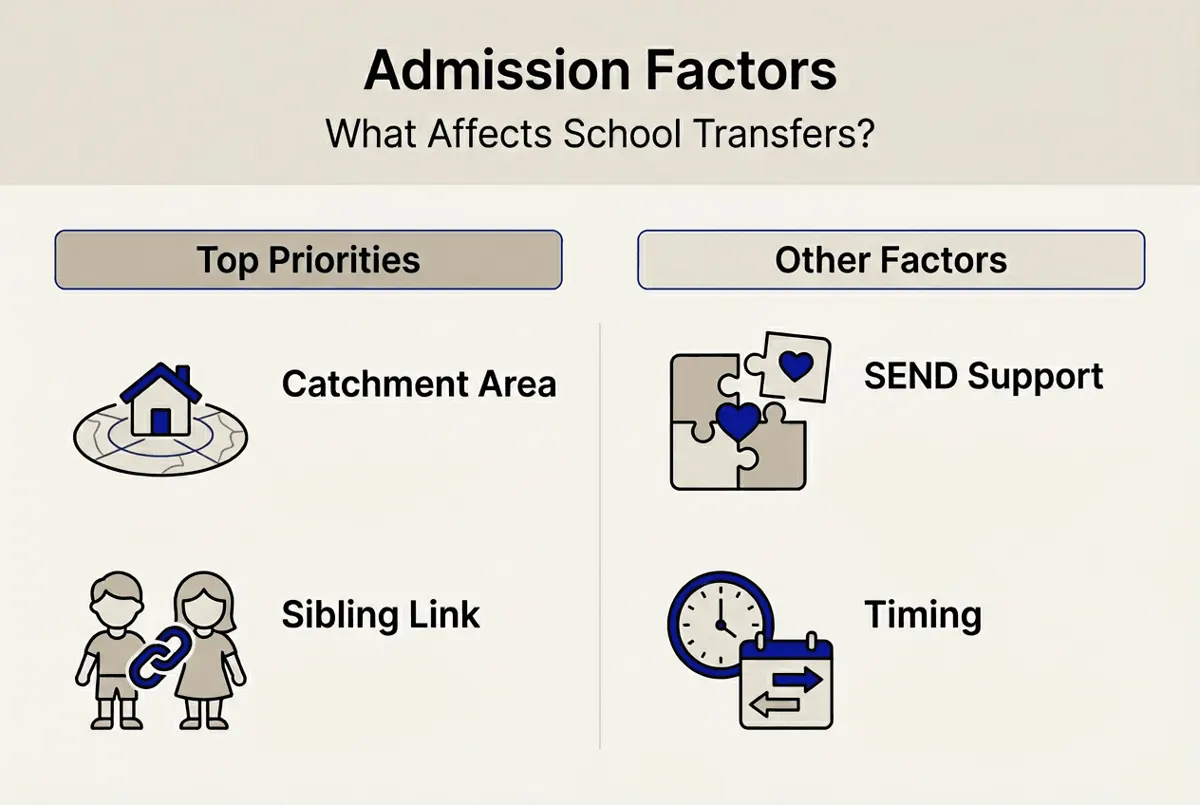
Catchment areas remain the single most influential factor in UK school admissions. These geographical boundaries determine which families receive highest priority for places, and neighbourhoods for relocation should be researched carefully before committing to a property. Catchment areas often determine school allocation and priority, particularly for oversubscribed schools where demand exceeds available places.

Distance measurements vary by school. Some measure straight-line distance from your front door to the school gate, whilst others use actual walking routes. A few hundred metres can make the difference between securing a place or joining a lengthy waiting list. Many families discover too late that their new home sits just outside the catchment for their preferred school, leaving them with less desirable options.
Sibling priority offers significant advantages in the admissions process. Most schools place children with brothers or sisters already attending near the top of their criteria, sometimes even above catchment considerations. This recognition of family cohesion means if your older child already attends a school, younger siblings stand a much stronger chance of admission. However, sibling priority typically only applies whilst the older child remains at the school, so timing matters when planning moves.
Special educational needs and disabilities (SEND) create additional pathways and considerations. Children with Education, Health and Care Plans (EHCPs) follow a separate process where the local authority must name a school in the plan. This provides stronger placement guarantees but requires advance planning and coordination between your current and new local authorities. Even without an EHCP, schools must consider reasonable adjustments and accessibility requirements in their decisions.
Application timing critically affects outcomes. Applying early, particularly before moving, allows you to secure a place before physically relocating. Some families use a temporary address with relatives or arrange short-term rentals in their target catchment area to establish residency. Late applications after all places are filled mean joining waiting lists where movement depends on other families leaving.
| Admission Criteria | Typical Priority Level | Impact on Placement |
|---|---|---|
| Looked after children | Highest | Guaranteed priority by law across all schools |
| SEND/EHCP naming school | Highest | Must be accommodated unless exceptional circumstances |
| Sibling attendance | High | Often overrides catchment in oversubscribed schools |
| Catchment residence | High | Primary factor for most community schools |
| Distance from school | Medium | Tiebreaker when other criteria equal |
| Parental preference | Low | Considered but doesn’t override published criteria |
Pro Tip: Check whether your target school uses a priority admission number (PAN) or published admission number. The PAN represents the school’s capacity, and once reached, further admissions require proving prejudice wouldn’t occur, making early application essential.
Other factors influencing admission include:
- Faith criteria for religious schools, requiring evidence of worship attendance
- Feeder school arrangements where certain primaries link to specific secondaries
- Staff children receiving priority in some academy chains
- Medical or social grounds requiring professional supporting evidence
- Random allocation or lottery systems used by some oversubscribed schools
Practical steps for a smooth school transfer during your move
Successful school transfers require methodical planning and proactive communication. Start by contacting both your current school and prospective schools at least two to three months before your intended move date. Your current school needs time to prepare transfer documents, academic records, and any SEND information. Meanwhile, prospective schools can advise on their specific application requirements and realistic availability based on current capacity.
Gathering documentation early prevents frustrating delays that could leave your child without a school place. Preparing required documents in advance can prevent delays in school transfers, particularly when councils require multiple proofs of address or certified copies of records. Council tax bills, tenancy agreements, and utility bills typically serve as address proof, but some authorities have specific requirements about document dates and whose name must appear.
Local authority deadlines for in-year admissions vary significantly across the UK. Whilst there’s no single national deadline for mid-year transfers, many councils process applications on specific dates each month or operate first-come, first-served systems. Missing a processing date could delay your child’s placement by several weeks. Contact your new local authority’s school admissions team immediately upon deciding to move, even before securing your new property.
Your child’s emotional wellbeing deserves equal attention alongside administrative tasks. School transfers disrupt friendships, familiar routines, and academic continuity. Involve your child in school visits where possible, maintain open conversations about their feelings, and coordinate with both schools to ensure pastoral support during the transition. Many schools offer buddy systems or gradual integration programmes for new students.
Follow these steps to organise your school transfer effectively:
- Research schools in your new area using Ofsted reports, league tables, and local parent forums to identify suitable options.
- Contact your new local authority’s school admissions team to understand their specific in-year application process and current vacancies.
- Inform your current school of your moving plans and request they prepare all transfer documentation including academic records and attendance history.
- Complete the in-year application form for your new local authority, listing your preferred schools in genuine order of preference.
- Gather required supporting documents including proof of new address, identification, and any SEND or medical evidence.
- Submit your application with all supporting documents, keeping copies of everything for your records.
- Follow up within one week if you haven’t received acknowledgement, as postal applications sometimes go astray.
- Once offered a place, confirm acceptance immediately in writing and arrange a start date with the new school.
- Coordinate the final day at the old school and first day at the new school to minimise time out of education.
- Arrange an induction visit or meeting with the new school’s pastoral team before your child’s first day.
Pro Tip: If you’re moving before securing a permanent property, use a relative’s address within your target catchment area temporarily, but be transparent with the local authority. Providing false address information constitutes fraud and can result in a place being withdrawn even after your child has started.
Additional practical considerations include:
- Requesting school uniform details early so your child arrives properly dressed
- Understanding transport arrangements, particularly for secondary schools with wider catchment areas
- Checking whether free school meals eligibility transfers automatically or requires reapplication
- Arranging after-school care or breakfast clubs if these featured in your previous routine
- Coordinating moving dates with school term dates where possible to avoid disrupting exams or key academic periods
Resources and support available for relocating families
Local authority school admissions offices serve as your primary resource throughout the transfer process. Every council maintains dedicated teams who can explain their specific procedures, check current vacancies, and guide you through applications. Their websites typically feature detailed admissions policies, catchment maps, and in-year application forms. Local councils provide essential guidance and resources for school admissions on relocation, particularly when navigating complex situations involving SEND or appeals.
Online tools have revolutionised how families research and compare schools. The government’s Get Information About Schools service provides comprehensive data on every state school in England, including performance metrics, Ofsted ratings, and contact details. Catchment area checkers, available through most council websites, let you enter a postcode and instantly see which schools you fall within boundaries for. School comparison websites aggregate performance data, parent reviews, and admissions statistics to help you make informed choices.
Support groups and forums offer invaluable peer advice from families who’ve navigated similar transfers. Mumsnet’s education forum hosts active discussions about specific schools and local authority experiences. Facebook groups organised by area or school provide real-time insights into application processes, waiting list movements, and settling-in experiences. Whilst anecdotal, these communities often highlight practical details that official sources overlook.
Specialist organisations provide targeted support for specific circumstances. The Advisory Centre for Education (ACE) offers free advice on admissions, appeals, and exclusions. IPSEA supports families navigating SEND processes and EHCP transfers between authorities. Citizens Advice can help with understanding your legal rights and challenging unfair decisions. These organisations prove particularly valuable when facing complex situations or disputes with schools or councils.
Key resources to bookmark include:
- Your new local authority’s school admissions webpage with in-year application forms and policies
- Get Information About Schools database for objective performance data and contact details
- Ofsted reports providing independent assessments of teaching quality and safeguarding
- Your new council’s family information service covering childcare, transport, and wraparound care
- School websites directly for open day dates, uniform requirements, and term calendars
- National admissions code published by the Department for Education explaining your statutory rights
- Local parent forums and community groups for peer experiences and recommendations
Simplify your move with Schott Removals

Navigating school transfers demands enough mental energy without the added stress of coordinating a house move. Schott Removals specialises in supporting UK families through every aspect of relocation, from packing fragile belongings to timing deliveries around your children’s school schedules. Our online estimate tool provides transparent pricing within minutes, helping you budget accurately for your move whilst focusing on school applications and family needs.
With over 30 years of experience in the removal industry, we understand that moving with children requires flexibility and reliability. Our team coordinates timing to minimise disruption to your family’s routine, and our secure storage solutions provide breathing room if your new home isn’t ready exactly when your old tenancy ends. Discover how moving made simple with Schott Removals means one less thing to worry about during this significant transition.
Frequently asked questions
Can I transfer my child to a new school at any time during the year?
Yes, children can transfer outside standard intake dates through the in-year admissions process. However, availability depends entirely on whether your preferred schools have vacant places in the relevant year group. Popular schools often operate waiting lists even mid-year, whilst others may have immediate vacancies. Contact your new local authority’s admissions team as early as possible to understand current availability and realistic timelines.
What documents are needed to apply for a school transfer when moving?
Most councils require proof of your new address such as a tenancy agreement or council tax bill, along with your child’s birth certificate and previous school records. Completed application forms naming your preferred schools in order must be submitted, usually online through the local authority portal. Some schools request additional documentation including medical information, SEND assessments, or proof of faith observance for religious schools. Check your specific council’s requirements as these vary across the UK.
How can I increase my child’s chances of getting into the preferred new school?
Apply as early as possible, ideally before physically moving, and ensure all application forms are completed accurately with supporting documents attached. Choose a property within the catchment area of your preferred school, as geographical priority typically ranks highest after looked-after children and SEND. If your child has siblings already attending the school, emphasise this in your application as it usually provides significant priority. Engage directly with both the school and local authority admissions team for guidance on strengthening your application.
Where can I find help if my school transfer application is refused?
Parents can appeal to the local authority’s independent admissions appeals panel, which examines whether correct procedures were followed and weighs individual circumstances. Request detailed written reasons for refusal immediately, as this informs your appeal strategy. Seek early advice from organisations like the Advisory Centre for Education (ACE) who provide free guidance on building strong appeals. Review admissions appeals guidance and prepare thoroughly by gathering supporting evidence such as medical reports or statements explaining why that specific school meets your child’s needs.