

Moving your business headquarters across Newcastle or expanding into new premises in Durham is never simply about packing up desks. For small business owners in the North East of England, a well-defined pre-move planning process is the heart of a successful relocation. Early, structured preparation addresses far more than logistics, helping you minimise risk, coordinate technology, and align your move with long-term business growth. This guide offers practical, research-backed insights to help transition your team and operations smoothly.
Table of Contents
- Defining Pre-Move Planning In Business Relocation
- Types Of Business Moves And Planning Variations
- Key Steps In Pre-Move Planning Process
- Legal And Regulatory Duties When Relocating
- Budgeting And Managing Relocation Costs
- Common Mistakes And How To Avoid Disruption
Key Takeaways
| Point | Details |
|---|---|
| Importance of Pre-move Planning | Effective pre-move planning ensures minimal operational disruption and aligns relocation with organisational strategies. |
| Types of Business Moves | Different move types demand tailored strategies, from local office shifts to international relocations, considering unique challenges for each. |
| Financial Management | Comprehensive budgeting and cost management are essential for anticipating financial implications and ensuring a successful transition. |
| Legal Compliance | Navigating legal and regulatory obligations is crucial for a seamless relocation and to avoid operational delays or penalties. |
Defining pre-move planning in business relocation
Business relocation represents a complex strategic decision involving comprehensive preparation and meticulous coordination. Pre-move planning emerges as a critical process that enables companies to transition operational environments with minimal disruption and maximum efficiency. In the North East of England, where small businesses form the economic backbone, understanding this process becomes paramount for sustainable growth.
According to government research, pre-move planning encompasses several key strategic dimensions:
- Assessing underlying relocation drivers
- Establishing clear business objectives
- Evaluating economic and operational impacts
- Developing comprehensive transition frameworks
- Minimising potential operational risks
The fundamental goal of pre-move planning is creating a structured decision-making approach that aligns physical relocation with broader organisational strategies. This involves detailed coordination predominantly led by IT and facilities management teams, who must audit critical infrastructure, assess telecommunications requirements, and develop migration strategies for technical systems.
Effective pre-move planning requires businesses to conduct thorough assessments across multiple operational domains. This includes reviewing current infrastructure, identifying potential challenges, and developing contingency protocols to maintain business continuity throughout the transition. Companies must create robust timelines, assign clear accountability, and ensure comprehensive oversight across all operational dimensions.
Successful business relocations are not about moving spaces, but strategically repositioning organisational capabilities.
Pro tip: Start your pre-move planning process at least six months before the anticipated relocation date to ensure comprehensive preparation and minimal operational disruption.
Types of business moves and planning variations
Business relocations are not a one-size-fits-all process, with multiple types of moves requiring distinct planning approaches. Relocation complexity varies significantly depending on the specific organisational context, from local office shifts to extensive international transitions. Understanding these variations is crucial for developing targeted, effective move strategies.
Businesses encounter several primary types of moves, each demanding unique planning considerations:
- Local Office Moves: Short-distance relocations within the same city or region
- Expansion Moves: Transitioning to larger premises to accommodate growth
- Consolidation Moves: Combining multiple office locations into a single site
- International Relocations: Cross-border moves involving complex logistical challenges
The planning variations for different move types demand nuanced strategic approaches. Local moves typically require shorter preparation timelines and minimal regulatory navigation, whereas international relocations necessitate extensive logistical coordination. These moves involve comprehensive considerations around staffing, infrastructure migration, customs compliance, and operational continuity.

Particularly in the North East of England, businesses must carefully assess their specific relocation requirements. Local moves might focus on operational seamlessness and employee communication, while larger-scale relocations demand more intricate planning protocols. Factors such as company size, industry sector, and geographical complexity significantly influence the move’s strategic framework.
Here is a concise comparison of key business move types and their distinct strategic demands:
| Move Type | Strategic Demand | Typical Challenge |
|---|---|---|
| Local Office Move | Rapid timeline execution | Minimising staff disruption |
| Expansion Move | Growth forecasting | Integrating new infrastructure |
| Consolidation Move | Efficient asset merging | Maintaining service continuity |
| International Relocation | Logistical coordination | Navigating customs and compliance |
Each business move represents a unique journey, requiring tailored planning that reflects organisational goals and operational constraints.
Pro tip: Conduct a comprehensive organisational audit at least nine months before your planned move to identify specific planning requirements and potential challenges.
Key steps in pre-move planning process
Successful business relocation hinges on a structured, comprehensive pre-move planning strategy that addresses multiple organisational dimensions. From small startups in Durham to established enterprises across the North East, a methodical approach ensures minimal operational disruption and seamless transition between business locations.
The core steps in the pre-move planning process include:
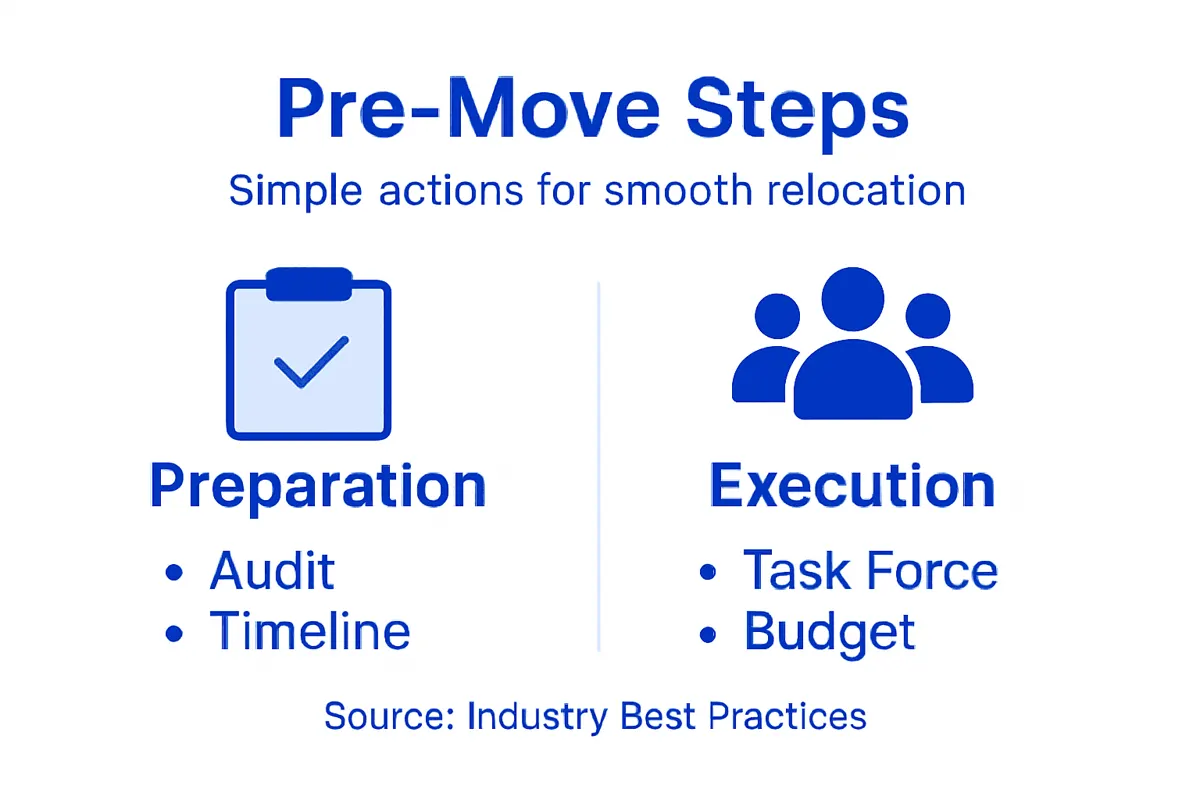
- Team Formation: Establishing a dedicated relocation project team
- Financial Planning: Creating detailed budgets and cost projections
- Asset Management: Conducting comprehensive inventory and auditing
- Technology Assessment: Mapping IT infrastructure and migration requirements
- Risk Management: Identifying potential challenges and developing mitigation strategies
- Stakeholder Communication: Developing clear communication plans for employees and key stakeholders
Businesses can develop comprehensive pre-move planning strategies that address critical operational considerations. This involves early strategic preparation, typically starting months in advance, with a focus on detailed scheduling, technological needs, health and safety protocols, and staff engagement. The planning process requires meticulous attention to financial implications, technological infrastructure, and organisational impact.
Particularly for businesses in the North East of England, the planning process must account for regional specificities. Local companies must consider factors such as regional economic conditions, transport infrastructure, and sector-specific challenges. This might involve consulting local business networks, understanding regional property markets, and ensuring compliance with local regulatory requirements.
Effective pre-move planning transforms a potential organisational challenge into a strategic opportunity for growth and transformation.
Pro tip: Create a detailed, colour-coded project timeline that breaks down each planning stage and assigns clear accountability to specific team members.
Legal and regulatory duties when relocating
Business relocations involve complex legal and regulatory obligations that extend far beyond simple physical movement. Companies in the North East of England must navigate a sophisticated landscape of statutory requirements to ensure a compliant and seamless transition between business locations.
Key legal and regulatory responsibilities include:
- Notifying local authorities about business address changes
- Updating company registration documents
- Reviewing and transferring commercial property leases
- Ensuring compliance with health and safety regulations
- Managing employee contract modifications
- Addressing tax and business rate implications
Businesses must undertake comprehensive legal due diligence when planning their relocation. This process involves meticulous coordination with regulatory bodies, ensuring all statutory notifications are completed, and maintaining strict adherence to local council requirements. Failure to comply can result in significant operational delays and potential financial penalties.
Specifically for businesses in regions like Durham and Darlington, understanding local regulatory nuances becomes crucial. Each local authority may have specific requirements regarding commercial property transitions, environmental impact assessments, and business infrastructure changes. Engaging with local business networks and potentially consulting legal professionals can provide invaluable guidance through these complex regulatory landscapes.
Legal compliance is not an option, but a fundamental requirement of any successful business relocation strategy.
Pro tip: Engage a specialist commercial solicitor with experience in business relocations to conduct a comprehensive legal audit at least three months before your planned move.
Budgeting and managing relocation costs
Navigating the financial landscape of business relocation requires meticulous cost management strategies that go beyond simple moving expenses. For businesses across the North East of England, particularly in dynamic regions like Durham and Darlington, understanding the comprehensive financial implications becomes crucial for a successful transition.
Key cost categories businesses must consider include:
- Direct moving and transportation expenses
- Infrastructure and technology setup costs
- Potential lease termination or transfer fees
- Staff relocation and training expenses
- Temporary operational disruption costs
- Equipment replacement or modification expenses
- Potential tax and legal consultation fees
Businesses can develop comprehensive relocation budgeting strategies that anticipate both expected and unexpected financial challenges. This involves creating detailed budget breakdowns at the project’s outset, implementing robust cost monitoring mechanisms, and maintaining flexible contingency funds to address unforeseen expenses. Effective financial planning also includes exploring potential grants or financial incentives specific to business relocations.
For small and medium enterprises in the North East, strategic financial planning goes beyond mere expense tracking. Companies must conduct thorough cost-benefit analyses, considering long-term operational efficiency, potential productivity gains, and the strategic value of the new location. This might involve comparing potential savings in rent, improved infrastructure, or access to better talent pools against the immediate relocation expenses.
This summary highlights the financial impacts of relocation decisions for small businesses:
| Expense Category | Short-Term Effect | Long-Term Benefit |
|---|---|---|
| Moving & transport costs | High initial outlay | Streamlined operations |
| Technology setup & upgrades | Investment in IT | Enhanced productivity |
| Lease transfer/termination | Possible penalty fees | Improved facility access |
| Staff relocation & training | Increased personnel costs | Stronger workforce loyalty |
| Legal & tax consultations | Specialist fees | Compliance reduces risk |
Successful business relocation budgeting is about strategic investment, not just expense management.
Pro tip: Create a detailed spreadsheet with three budget scenarios: conservative, moderate, and optimistic, to provide financial flexibility during your relocation process.
Common mistakes and how to avoid disruption
Business relocations can quickly unravel without meticulous strategic planning and risk management. Companies in the North East of England, from small startups in Durham to established enterprises in Darlington, must anticipate potential pitfalls to ensure a smooth operational transition.
Common mistakes that can derail business relocations include:
- Inadequate timeline and project management
- Insufficient stakeholder communication
- Neglecting technology and infrastructure requirements
- Underestimating total relocation costs
- Failing to create comprehensive contingency plans
- Overlooking employee impact and engagement
- Ignoring potential legal and regulatory compliance issues
Businesses can minimise operational disruption through structured planning by implementing rigorous project tracking, developing detailed checklists, and creating phased execution strategies. This approach involves anticipating potential challenges, maintaining clear communication channels, and developing flexible contingency frameworks that allow rapid adaptation to unexpected circumstances.
In the context of regional business environments like the North East, understanding local dynamics becomes crucial. Companies must consider unique regional factors such as infrastructure limitations, local talent pool characteristics, and sector-specific challenges. Successful relocation strategies involve comprehensive risk assessments that go beyond generic planning, incorporating nuanced understanding of local business ecosystems.
Effective business relocation is not about eliminating risks, but about developing robust strategies to manage and mitigate potential disruptions.
Pro tip: Create a dedicated relocation task force with representatives from each department to ensure comprehensive oversight and multi-perspective problem-solving.
Expert Pre-Move Support to Keep Your Business Moving Smoothly
Preparing for a business relocation demands strategic foresight to avoid costly disruptions and operational downtime. As the article highlights, thorough pre-move planning involves assessing key relocation drivers, managing complex logistics, and navigating legal obligations. Many businesses struggle with challenges such as timeline management, stakeholder communication, and infrastructure migration. These pain points can put your business continuity at risk without the right support.
Schott Removals offers tailored solutions designed to complement your pre-move strategy with professionalism and reliability. Whether you need specialised office removals, secure storage options, or assistance with national and European relocations, our experienced team ensures every aspect aligns with your operational goals. Benefit from over 30 years of expertise and peace of mind knowing your business move is in trusted hands.
Discover how our satisfied clients have experienced smooth transitions by reading real feedback in our Testimonials Archives – Schott Removals.
Avoid the common pitfalls of business relocation by choosing a partner who understands the importance of detailed planning and flawless execution. Visit Schott Removals today to explore comprehensive moving and storage services tailored to your pre-move planning needs. For insights on operational challenges and how we address them, check out our Uncategorised Archives – Schott Removals. Reach out now to secure your move date and take the first step towards a disruption-free business relocation.
Frequently Asked Questions
What is pre-move planning in business relocation?
Pre-move planning is a critical process that involves comprehensive preparation and coordination to ensure a smooth transition when relocating a business. It focuses on assessing relocation drivers, establishing objectives, evaluating impacts, minimising risks, and ensuring alignment with organisational strategies.
How can businesses ensure minimal disruption during a relocation?
Businesses can ensure minimal disruption by conducting thorough assessments of their operations, developing detailed timelines, creating contingency protocols, and maintaining clear communication with stakeholders throughout the relocation process.
What are the common mistakes to avoid during a business relocation?
Common mistakes include inadequate timeline management, poor stakeholder communication, neglecting technology needs, underestimating costs, and failing to create contingency plans. Addressing these areas can improve the chances of a successful relocation.
How important is legal and regulatory compliance when relocating a business?
Legal and regulatory compliance is essential as it involves notifying local authorities, updating company registrations, reviewing leases, and adhering to health and safety regulations. Non-compliance can lead to operational delays and financial penalties.
Recommended
- Commercial Relocation Checklist 2025: Essential Steps for UK Moves | Schott Removals
- The Complete Office Removals Process Guide for 2025 | Schott Removals
- What to Expect on Moving Day in the UK: Key Steps in 2025 | Schott Removals
- Commercial Removals Process Guide 2025 for North East Moves | Schott Removals
- 7 Essential Tips for a Smooth Commercial Moving Checklist