
Every family faces the real test of keeping their belongings safe when moving out of County Durham or even further abroad. Packing for a major relocation is more than just fitting things into boxes—it is about avoiding costly breakages and keeping stress levels in check. With careful organisation, using inert, chemically stable packing materials and a clear inventory system, you can protect prized possessions and confidently track every item, making your UK move much smoother.
Table of Contents
- Step 1: Organise Packing Supplies And Create An Inventory
- Step 2: Sort And Declutter Belongings For Efficient Packing
- Step 3: Protect Fragile Items Using Proper Wrapping Techniques
- Step 4: Pack Boxes Methodically By Room And Label Clearly
- Step 5: Check Box Weight And Seal For Transport Readiness
Quick Summary
| Key Insight | Explanation |
|---|---|
| 1. Organise packing supplies first | Gather sturdy boxes, tape, and materials to avoid future issues during your move. |
| 2. Create a detailed inventory system | Number each box and record its contents to easily locate items at your new home. |
| 3. Sort belongings before packing | Categorise items into keep, donate, and discard to reduce clutter and packing time. |
| 4. Wrap fragile items carefully | Use appropriate wrapping materials to prevent damage to delicate belongings during transport. |
| 5. Check box weight and seal properly | Ensure boxes are not overloaded and securely sealed to protect contents and ease handling. |
Step 1: Organise packing supplies and create an inventory
Before you pack a single box, you need to gather the right supplies and establish a system for tracking everything. This foundational step takes a few hours upfront but saves you countless headaches during and after your move. When you’re relocating your family from somewhere like Darlington to another part of County Durham or further afield, knowing exactly what you have packed and where it is becomes invaluable.
Start by assessing what supplies you actually need based on your belongings. Walk through your home and evaluate the items you’ll be packing. Consider their material composition, current condition, size, and any special handling requirements. A lamp, for instance, needs different protection than a stack of books or a ceramic serving dish. Inert, chemically stable packing materials ensure that nothing deteriorates during transport and that your belongings arrive in the same condition they left. Gather sturdy boxes in various sizes, quality packing tape, bubble wrap, kraft paper, packing peanuts, and marker pens. Don’t skimp here; cheap boxes collapse under weight, and poor tape fails mid-move. You’ll also want wardrobe boxes for hanging clothes, as these save you time and keep garments crease-free. Many people forget about specialised boxes for dishes and glasses, which are well worth the investment.
Once your supplies are organised and ready, create a comprehensive inventory system. This is where clear naming conventions and hierarchical organisation become your best friend. Assign each box a unique number and use consistent labelling across all containers. Instead of just writing “Kitchen,” try “Kitchen pots and pans,” “Kitchen glasses,” or “Kitchen small appliances.” This specificity means you can locate items quickly without opening every single box. Create a simple spreadsheet or use a notebook to record box numbers alongside their contents and which room they belong in. Note fragile items clearly, as this information helps both you and any moving professionals understand which boxes need careful handling. If you’re using professional removals services, such as those offered by Schott Removals, this detailed inventory proves invaluable when items need to be located or when you’re unloading at your new property. Numbering your boxes sequentially also prevents duplicates and helps you confirm nothing has gone missing during the move.
When organising your supplies, dedicate a specific space in your home as your packing station. Keep all your boxes, tape, markers, and wrapping materials in one place so you’re not hunting for supplies as you work through each room. Colour coding your boxes by room adds another layer of organisation, particularly helpful if you’re moving with children who can easily identify which boxes belong to their space. Your inventory document should live in multiple places: one printed copy kept with your important documents, one digital version on your phone, and ideally one copy with the moving company if you’ve hired professionals.
Here is a quick reference for choosing suitable packing materials for different household items:
| Item Type | Recommended Material | Reason for Choice |
|---|---|---|
| Glassware | Bubble wrap, kraft paper | Prevents shattering and abrasion |
| Electronics | Anti-static bubble wrap | Minimises electrical damage |
| Clothing | Wardrobe box, tissue paper | Reduces creasing and dust build-up |
| Books | Small sturdy boxes | Prevents excess weight and rips |
| Kitchen plates | Kraft paper, foam sheets | Shields against impact and chips |
Pro tip Number your boxes before you start packing and keep your inventory up-to-date as you go, rather than trying to document everything after you’ve finished packing. This approach prevents gaps in your records and means you can answer “Where did I pack that?” with confidence throughout the moving process.
The following table compares inventory tracking systems and their key advantages for home moves:
| Method | Accessibility | Organisation Level |
|---|---|---|
| Paper notebook | Always on hand, tangible | Simple, manual sorting |
| Spreadsheet (digital) | Easily updated, searchable | Highly structured, filterable |
| Removal company inventory | Coordinated with movers | Professional, detailed |
| Phone photo log | Immediate reference, visual | Supports lost item claims |
Step 2: Sort and declutter belongings for efficient packing
Before you start wrapping items and filling boxes, take time to sort through your belongings and eliminate what you no longer need. This step might feel tedious, but it transforms your move from overwhelming to manageable. You’ll pack fewer items, spend less time organising, and arrive at your new home in County Durham or elsewhere without unnecessary clutter weighing you down.
Begin by going through each room systematically and creating three categories: keep, donate, and discard. Be honest with yourself about items you haven’t used in the past year. That bread maker gathering dust in the kitchen cupboard, the stack of books you’ll never reread, the clothes that don’t fit anymore, the broken furniture you’ve been meaning to fix but never will. These are prime candidates for removal. Pick up each item and ask yourself whether it genuinely serves your life now or whether it’s just taking up space. This decision making process sounds simple but requires real thought. Many people feel guilty about getting rid of things, especially gifts or expensive purchases. Remind yourself that donating items to charity gives them a second life with someone who will actually use them, and that’s far better than packing them into a moving lorry just to store them in your new home.
Once you’ve sorted your belongings, consider the waste hierarchy and how to handle each category responsibly. Donating usable items to local charities reduces waste while supporting your community, and many organisations offer collection services if you have larger pieces. Textiles, electronics, and other materials should be recycled according to your local council guidelines rather than sent to landfill. Following proper recycling and waste disposal rules ensures you’re not charged extra disposal fees during your move and helps protect the environment. Contact your local authority in Darlington or your destination area to understand their specific systems. Some councils offer bulky waste collection services for free or at a small charge, which can be particularly useful for old furniture or large appliances. Take photographs of items you’re selling online, as this provides both documentation and potential income to offset moving costs.
As you declutter, you’ll notice your pile of items to pack shrinking considerably. This efficiency gain means you’ll need fewer boxes, less packing material, and ultimately lower removal costs if you’re hiring professionals. It also means unpacking at your destination takes significantly less time. You might discover items you forgot you owned, which can be exciting, but don’t let nostalgia convince you to keep everything. The goal is to arrive at your new property with only the belongings that genuinely matter to you and serve your current lifestyle.
Pro tip Schedule your decluttering across several weekends rather than trying to tackle everything at once, as decision fatigue makes it harder to be objective about what to keep. This paced approach also gives you time to arrange donations and sales before packing begins in earnest.
Step 3: Protect fragile items using proper wrapping techniques
Fragile items demand your full attention during packing. When plates, glassware, ornaments, and other delicate belongings suffer damage during a move, they’re often irreplaceable, whether for sentimental or practical reasons. Mastering proper wrapping techniques means your treasured items arrive at your new home in perfect condition, ready to be displayed and enjoyed rather than discarded.
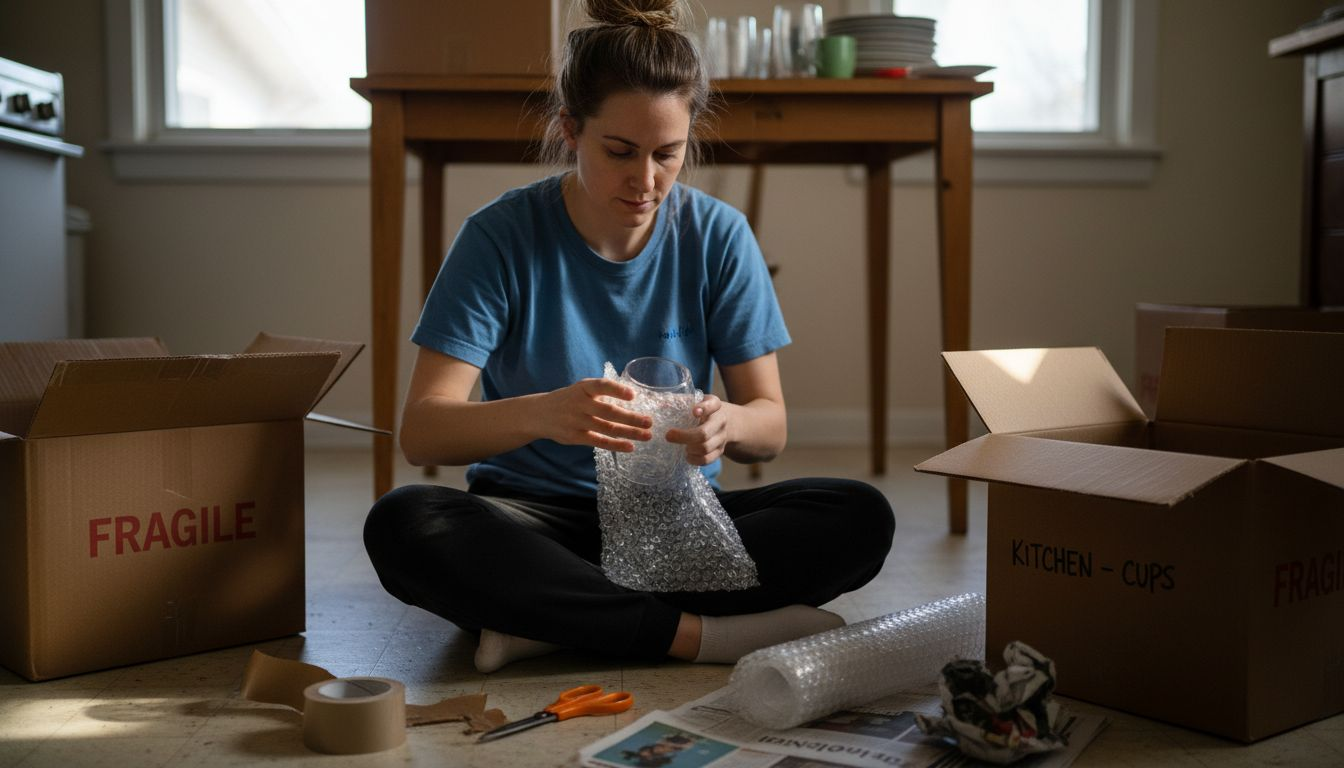
Start by understanding what makes an item fragile and what protection it needs. A ceramic dinner service requires different handling than wine glasses, which differ again from a framed painting or a decorative mirror. Take time to examine each piece and assess its vulnerability to impact, pressure, and abrasion. Gather your wrapping materials before you begin. Bubble wrap, kraft paper, packing paper, and foam sheets all serve different purposes when wrapping fragile goods. Begin by wrapping each individual item separately rather than grouping several pieces together. This prevents items from clinking against one another and causing damage. Wrap plates individually by standing them upright and wrapping them in several layers of bubble wrap or kraft paper, securing the ends with tape. For stemware and drinking glasses, wrap the base first, then spiral the wrapping material up around the stem and bowl, ensuring no part is left exposed. Adequate cushioning and stable packaging minimises the risk of breakages during transport, so don’t skimp on materials. Once each item is wrapped, place it in a box with additional padding between pieces. Fill any empty spaces with packing peanuts, crumpled paper, or foam sheets so items cannot shift during the journey. The goal is to create a buffer between each fragile item and the box walls.
When packing boxes of fragile goods, follow the principle of stability and weight distribution. Place heavier wrapped items at the bottom of the box and lighter items on top, preventing crushing. Fill boxes only to the point where you can gently press down on the contents without meeting resistance. Overstuffed boxes become unstable and may collapse or break open during loading. Mark every box containing fragile items clearly with the word “Fragile” on multiple sides, along with an arrow indicating which side should face upwards. This visual marker helps you, your family, and any professional movers understand that these boxes require careful handling. When transporting fragile items, keep them in your personal vehicle rather than the removal lorry if possible, giving you direct control over their protection. If you’re moving within the North East or across the UK with a company like Schott Removals, inform them of fragile items and discuss any special handling arrangements beforehand. They have experience securing delicate goods and can offer valuable advice specific to your collection.
Consider creating a fragile items inventory separate from your main moving list, documenting exactly what’s packed and in which box. Photograph valuable or sentimental items before packing them, providing both proof of condition and a visual record should you need to make insurance claims. Some people find it helpful to video record themselves wrapping particularly precious items, narrating what they’re packing and how they’re protecting it. This documentation takes just a few minutes but offers significant peace of mind. When unpacking at your new location, unwrap fragile items carefully and inspect them immediately, checking that nothing suffered damage in transit.
Pro tip Invest in quality packing materials designed specifically for fragile items rather than improvising with newspaper or old clothing, as specialist materials provide superior protection and make the wrapping process faster and more effective.
Step 4: Pack boxes methodically by room and label clearly
Packing room by room and labelling systematically transforms what could be a chaotic unpacking process into something manageable and straightforward. When you arrive at your new home in the North East or elsewhere, you’ll open boxes knowing exactly what’s inside and where each item belongs. This approach prevents the frustration of searching through countless unmarked boxes and helps you settle into your space quickly.
Begin by dedicating time to pack one room completely before moving to the next. Start with spaces you use less frequently, such as spare bedrooms or formal lounges, then progress to everyday areas like the kitchen and bedrooms. This pacing allows you to keep one room functional for as long as possible while you’re preparing for the move. As you pack each room, resist the temptation to mix items from different areas into the same box. A box containing kitchen utensils, bedroom linens, and bathroom products might seem efficient at the time, but it creates nightmares during unpacking. Instead, keep bathroom items together, kitchen equipment grouped, and bedroom belongings separate. Organising packed items by room or function streamlines the unpacking process and helps locate items quickly, making the transition to your new property far less stressful. Within each room, you can further subdivide. Kitchen boxes might contain plates, glasses, cutlery, or small appliances. Bedroom boxes might hold clothing, bedding, or books. This additional layer of organisation means you can unpack methodically, setting up one room completely before moving to the next.
Labelling is where many people rush, and it’s precisely where you shouldn’t. Take time to create a clear, consistent labelling system that works for you. Use a permanent marker and write on at least two visible sides of each box so you can read the label from any angle. Include three key pieces of information: the room destination, the category of contents, and ideally the date you packed it. For example, “Master Bedroom Clothing August 2024” tells you exactly where the box goes and what’s inside. Some people include a brief list of major items, particularly useful for boxes containing expensive or valuable goods. “Kitchen Crockery – plates, bowls, cups” gives you more detail than just “Kitchen” and helps you find specific items without opening the box. If you’re using a colour coding system, apply a coloured sticker or stripe of tape to each box in addition to written labels, providing a visual quick reference alongside written information. Assigning responsibility for packing and labelling helps ensure all boxes are clearly marked by their contents and room of origin, so if family members are helping, brief them on your system so everyone labels consistently.
Create a master inventory document listing every box by number, room destination, and contents. This document serves multiple purposes. It helps you confirm nothing has gone missing during transport, allows you to locate items quickly after moving, and provides documentation should you need to make insurance claims for damage. Keep one copy with you during the move, one with your removal company if you’ve hired professionals like Schott Removals, and a digital copy on your phone for reference. As you pack each box, assign it a sequential number and record that information immediately rather than trying to document everything after you’ve finished packing. This prevents gaps in your records and ensures accuracy. Number your boxes visibly on top and at least one side, making them easy to track throughout the moving process.
Pro tip Pack an essentials box last and label it clearly as “Open First,” containing items you’ll need immediately upon arrival such as toiletries, phone chargers, medications, important documents, a change of clothes, and basic kitchen items, ensuring you’re not rummaging through dozens of boxes on your first night.
Step 5: Check box weight and seal for transport readiness
Before your boxes leave your home, they need to pass two critical checks: weight verification and seal integrity. Overloaded boxes collapse during handling, damage your belongings, and risk injury to anyone lifting them. Poorly sealed boxes allow contents to spill, expose items to weather and dirt, and create mess throughout your removal vehicle. Taking time to check each box ensures everything arrives at your new home in perfect condition and that moving day runs smoothly.
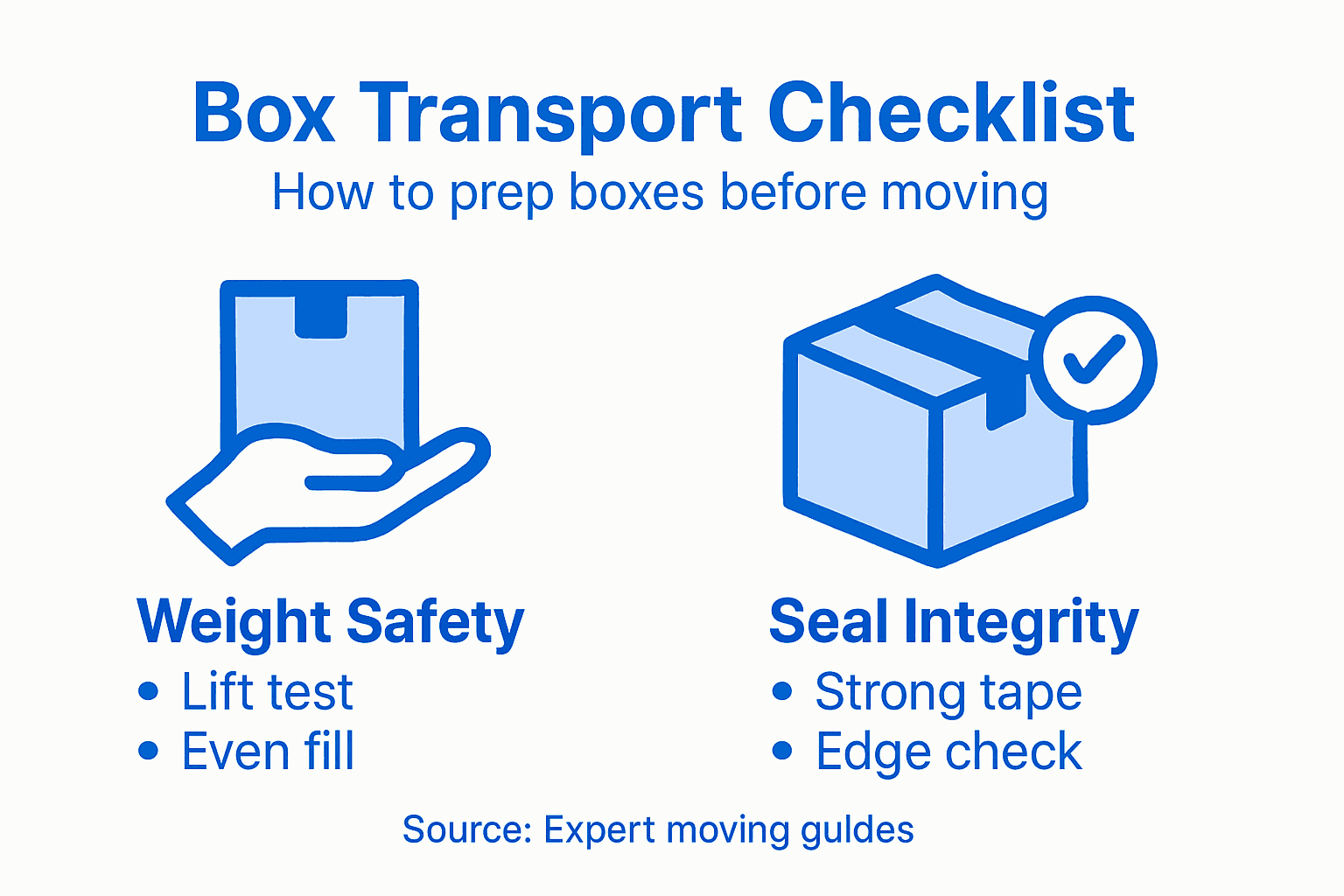
Start by testing the weight of each box as you finish packing it. Pick up the box and assess whether you could comfortably lift it and carry it for several metres. If you’re struggling or unsure, the box is too heavy. Aim for boxes that weigh no more than 20 to 25 kilograms for most people, though this varies depending on your own strength and mobility. Books and other dense items fill boxes quickly and create surprisingly heavy loads, so don’t underestimate how much weight you’ve added. If a box feels too heavy, remove some items and redistribute them to another container. This approach takes a few extra minutes but prevents back injuries and damaged boxes. Overloading can cause damage to the box and injury during lifting, so never force items into boxes simply to reduce the total number of containers you’re packing. Remember that professional movers and your family members will be handling these boxes repeatedly, so reasonable weight distribution matters considerably. Label heavier boxes clearly as “Heavy” so anyone moving them knows to take appropriate care and use correct lifting techniques.
Once you’ve confirmed weight is manageable, turn your attention to sealing. Quality matters here. Cheap, thin tape tears easily and fails during transport, leaving boxes vulnerable. Invest in proper packing tape, sometimes called parcel tape or box tape, which adheres firmly and withstands the rigours of moving. Start by sealing the bottom of the box with at least two long strips of tape running across the entire width. Overlap each strip slightly so there are no gaps where contents might shift or spill. Then seal the top of the box the same way, ensuring tape runs along all seams. Pay particular attention to the corners and edges where boxes are most likely to fail under pressure. If your box contains fragile items or heavy goods, consider adding reinforcing tape along the vertical seams as well, creating a stronger structure. Run your hands along the sealed edges to confirm the tape is pressed firmly and won’t peel back. Stack sealed boxes carefully, placing heavier boxes on the bottom and lighter boxes on top, as this prevents crushing and reduces strain on box seams. Health and Safety Executive regulations emphasise the importance of handling packed items safely through adherence to weight limits and secure sealing, ensuring both your wellbeing and compliance with safety standards throughout your move.
Before boxes are loaded onto the removal vehicle, do a final walk through. Check that every single box is sealed and hasn’t been damaged during your packing process. Look for dents, tears, or areas where tape has come loose. If you spot a problem, address it immediately rather than hoping it holds during transport. For boxes heading into professional storage or long distance removal, this extra vigilance is particularly important. Keep a master list noting which boxes have been checked and sealed, helping you confirm nothing has been missed. If you’re using Schott Removals or another professional service, they’ll conduct their own inspection, but starting with properly sealed boxes sets the right tone and demonstrates your attention to detail.
Pro tip Use a colour coded tape system where you mark boxes with different coloured tape depending on their destination or fragility level, making it instantly visible during loading whether boxes need special handling and helping the moving team prioritise boxes correctly without needing to read every label.
Simplify Your Move with Expert Packing and Removals Support
Packing fragile and valuable items carefully while organising your entire home can feel overwhelming. The challenge of managing fragile wrapping techniques alongside box labelling and weight limits often leads to stress and uncertainty about whether your belongings will arrive safely. If you want to avoid last-minute packing chaos and ensure everything is packed securely by experienced professionals, Schott Removals is here to help. With over 30 years of family-run experience, they understand the importance of methodical packing and use proven systems to protect your possessions throughout your move.

Discover how their specialised packing services and expert removals can take the pressure off your shoulders. Whether you are moving locally in Darlington or planning a national or international relocation, their skilled team offers tailored solutions with clear labelling, fragile item protection, and reliable transport. Don’t wait until moving day to realise your belongings need extra care. Visit Schott Removals now and explore customer stories in the Testimonials Archives – Schott Removals to see why families trust them to safeguard their move. For useful tips beyond packing, browse the Uncategorised Archives – Schott Removals and plan your smooth transition with confidence.
Frequently Asked Questions
What packing supplies do I need for a successful move?
Gather sturdy boxes in various sizes, quality packing tape, bubble wrap, kraft paper, and packing peanuts. Ensure you also have wardrobe boxes for hanging clothes and specialised boxes for fragile items like dishes.
How should I create an inventory before packing my belongings?
Assign each box a unique number and label clearly with the contents and room destination. Maintain a master list to track the box numbers alongside their details to locate items quickly during the move.
What are effective techniques for packing fragile items?
Wrap each fragile item individually in bubble wrap or kraft paper, and ensure they are packed with adequate cushioning in sturdy boxes. Use markers to label these boxes as “Fragile” and include details about the contents for easy handling.
How can I avoid overpacking boxes and ensure safe transport?
Weigh each box as you pack it, aiming for a maximum weight of 20 to 25 kilograms. If a box feels too heavy, redistribute items into additional containers to prevent strain and potential damage.
What essential items should be packed in an “Open First” box for moving?
Include crucial items like toiletries, phone chargers, medications, important documents, and a change of clothes in your “Open First” box. Clearly label this box to ensure it is the first one accessed upon arrival at your new home.
How should I label my boxes for efficient unpacking?
Use permanent markers to label at least two sides of each box with the room destination and contents. Incorporate a colour coding system if desired, which provides a quick visual reference to assist in identifying box categories.
Recommended
- Managing Moving Day Logistics: Expert Tips for UK Moves 2025 | Schott Removals
- Stress-Free Moving Checklist 2025: UK, International & Business Moves | Schott Removals
- Top Benefits of Professional Packers for UK & International Moves 2025 | Schott Removals
- Darlington Removals: Trusted Services for House and Office Moves 2025 | Schott Removals
- 8 Essential Items on Your Packing Checklist for Austin | Trinity Concierge
- Moving & Junk Removal Services | One-Stop Moving Solution