
Planning an office move in Darlington or the North East of England can quickly feel daunting when you consider business cycles, lease deadlines, and staff needs all at once. For small business owners and managers, timing every step is key to keeping operations smooth and stress levels low. This guide highlights the value of a strategic move schedule and clear communication to ensure your office relocation stays organised and disruption is kept to a minimum.
| Key Point | Explanation |
|---|---|
| 1. Assess operational needs thoroughly | Engage teams across departments to evaluate current workspace and future requirements to support productivity and growth. |
| 2. Identify optimal moving dates | Schedule your relocation during quieter business periods to minimise disruption and coordinate effectively with contractors and departments. |
| 3. Foster effective communication | Establish clear communication channels for all stakeholders to keep everyone informed and reduce anxiety during the transition. |
| 4. Finalise logistics meticulously | Create a detailed checklist and timeline, confirming responsibilities to ensure a smooth moving process and minimise risks. |
| 5. Prepare for potential risks | Anticipate challenges by developing mitigation strategies, such as scheduling IT migrations during off-hours to prevent downtime. |
When preparing for an office move, understanding your organisation’s operational requirements is a critical first step that sets the foundation for a smooth transition. The goal is to thoroughly evaluate your current workspace and anticipate future business needs, ensuring your new location supports your team’s productivity and growth.
To conduct a comprehensive assessment, start by gathering input from key departments. Form a dedicated relocation project team that includes representatives from IT, HR, finance, and operations. This cross-functional approach helps capture diverse perspectives and organisational requirements. Consider the following key evaluation areas:
A strategic assessment performed 12-18 months before relocation minimises potential disruptions and supports a more seamless transition.
Carefully document your findings, creating a detailed report that outlines both current operational constraints and future aspirations. Evaluate your current office space thoroughly to understand what works well and what needs improvement. This analysis will guide your selection of a new workspace that not only meets your immediate needs but also provides flexibility for future expansion.
Top tip: Create a comprehensive spreadsheet tracking all departmental requirements, allowing for easy comparison and prioritisation during your office move planning.
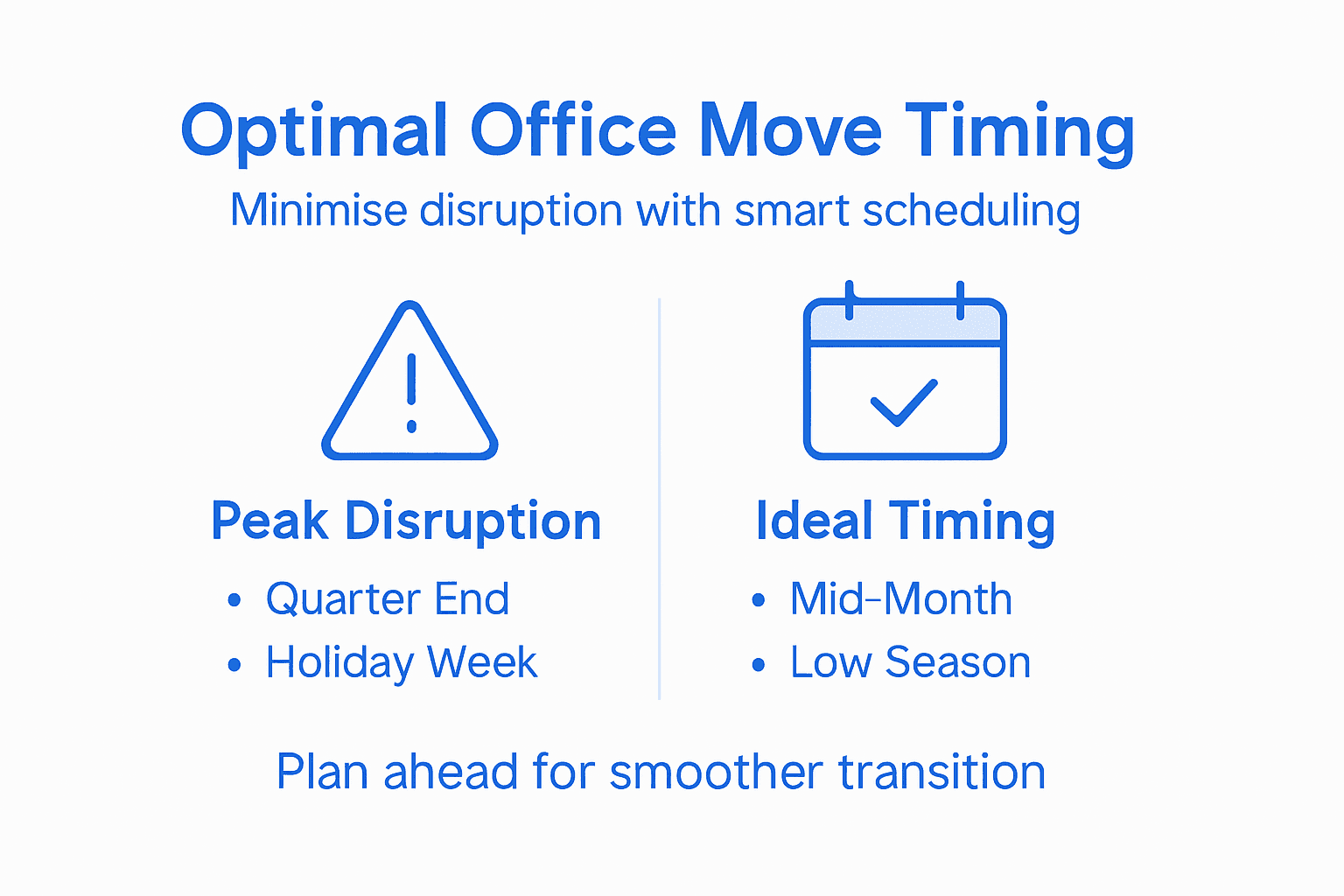
Pinpointing the right timing for your office relocation is crucial to minimising business disruption and ensuring a smooth transition. Your primary objective in this stage is to carefully select move dates that align with your organisation’s operational rhythms and strategic planning.
Begin by reviewing lease expiration timelines and establishing a comprehensive moving schedule. Strategic planning typically involves preparing 12-18 months in advance, allowing ample time for comprehensive logistics management. Key considerations for scheduling include:
Scheduling your move during traditionally slower business periods can significantly reduce operational disruptions and associated risks.
Consider creating a detailed timeline that breaks down critical milestones. Coordinate move dates with contractors well in advance, ensuring smooth transitions for technology setup, furniture installation, and potential workspace modifications. Build in buffer periods to accommodate unexpected challenges and prevent last-minute complications.
Top tip: Develop a colour-coded project timeline spreadsheet that tracks every departmental requirement and move-related deadline to maintain clear visibility and accountability.
Successful office relocation hinges on effective communication and collaboration with your team and external moving partners. Your goal is to create a transparent, inclusive process that keeps everyone informed and aligned throughout the transition.
Comprehensive office move planning requires establishing clear communication channels and defining roles and responsibilities for both internal staff and external moving partners. Begin by forming a dedicated relocation communication team responsible for managing information flow and addressing potential concerns. Key coordination activities include:
Transparent communication minimises uncertainty and helps maintain employee morale during significant organisational changes.
Ensure that each department understands their specific responsibilities and timelines. Develop detailed moving day transition plans that outline exact responsibilities for staff members, including packing protocols, equipment handling, and personal workspace management. Maintain open dialogue with your moving partners, providing them with comprehensive briefings about your organisation’s unique requirements and expectations.

Top tip: Create a shared digital dashboard where staff can track move progress, ask questions, and access real-time updates to foster transparency and reduce anxiety.
Here is a summary of key planning roles for a successful office move:
| Planning Role | Main Responsibility | Business Impact |
|---|---|---|
| Project Team | Oversee full move process | Ensures all functions are represented |
| Departmental Coordinator | Relay team needs and updates | Reduces miscommunication risks |
| External Moving Partner | Manage transport and logistics | Enables professional move management |
| Communication Lead | Owns stakeholder communication | Maintains engagement and assurance |
Effective communication is the cornerstone of a successful office move, ensuring all parties are informed, prepared, and aligned throughout the transition. Your primary objective is to create a comprehensive communication strategy that reaches every relevant stakeholder with clear, timely information.
Develop a structured communication plan that addresses the specific needs of different stakeholder groups. This involves crafting tailored messages for various audiences, including:
Transparent and consistent communication reduces uncertainty and maintains organisational confidence during significant transitions.
Prepare a detailed communication timeline that outlines when and how different stakeholders will receive information. This might include initial announcement emails, follow-up meetings, progress updates, and final relocation confirmation notices. Ensure each communication provides specific details about move dates, potential service interruptions, and new contact information.
Top tip: Create a centralised communication log to track all stakeholder communications, ensuring no group is overlooked and maintaining a comprehensive record of your outreach efforts.
As your office move approaches, meticulously verifying logistics becomes paramount to ensuring a seamless transition. Your goal is to create a comprehensive, foolproof plan that anticipates potential challenges and provides clear guidance for every aspect of the relocation.
Coordinate final moving logistics by developing a detailed verification checklist that covers every critical element of the move. This comprehensive review should encompass multiple operational dimensions:
Thorough verification minimises risk and ensures a structured, predictable moving process that reduces potential operational downtime.
Conduct a final walkthrough with your moving partners, reviewing each critical checkpoint and confirming specific responsibilities. Develop a minute-by-minute moving day timeline that outlines exact procedures, including equipment disconnection, transportation sequences, and new workspace setup protocols. Ensure all team members understand their specific roles and have clear instructions for managing their individual and departmental transitions.
Top tip: Create a digital move day dashboard with real-time tracking and communication channels to provide instant updates and rapid problem-solving capabilities during the relocation.
The following table highlights common office move risks and recommended mitigation actions:
| Potential Risk | Example Scenario | Mitigation Action |
|---|---|---|
| IT Downtime | Delayed server setup | Schedule after-hours migration |
| Lost Equipment | Missing labelled assets | Create detailed inventory list |
| Staff Disruption | Unclear task assignments | Provide written instructions |
| Missed Deadlines | Overlooked project milestone | Use centralised tracking tools |
Scheduling your office move at the right time is essential to avoid business disruption and maintain productivity. This article highlights key planning goals such as choosing optimal move dates, coordinating with staff and partners, and finalising logistics well in advance to keep operations running smoothly. Avoid the stress of missed deadlines, IT downtime, and staff uncertainty by partnering with a reliable moving company that understands these challenges.
Schott Removals, a family-run company with over 30 years of experience, specialises in professional removals and storage tailored to your business needs. With expert coordination and transparent services, we ensure your move follows the best scheduling and communication strategies as outlined in Uncategorised Archives – Schott Removals.

Ready to minimise disruption and make your office move seamless and timely Visit Schott Removals now to explore our comprehensive relocation solutions. Hear from our satisfied clients in Testimonials Archives – Schott Removals and get a free quote today to secure your ideal move date and expert moving support.
The best time to schedule an office move is during traditionally slower business periods, such as holidays or after key deadlines. Aim for a timing that aligns with your organisation’s operational cycles, ideally giving yourself 12-18 months for planning.
Begin your office move planning at least 12-18 months beforehand to ensure you have ample time for logistics and coordination. Create a detailed timeline that includes key milestones and deadlines to stay organised throughout the process.
Consider factors like your current lease expiration, business cycle patterns, and projected quiet periods. Aligning your move with these factors can help minimise disruptions; aim to choose dates that fit well with your company’s operational rhythms.
Develop a structured communication plan to ensure all stakeholders receive timely updates about the move. Include regular announcements, clear timelines, and specific details on any service interruptions to keep everyone informed and confident during the transition.
Common risks during office moves include IT downtime and lost equipment. Mitigate these risks by thoroughly planning your IT migration schedule and creating an inventory list of all assets to ensure everything is managed effectively during the move.
Keep your staff informed by holding regular team meetings and establishing clear roles and responsibilities. Encourage feedback and questions to ensure everyone understands their tasks, reducing confusion and keeping morale high during the transition.
Unit 20, Lingfield Point
McMullen Road,
Darlington
DL1 1RW
Telephone: 01325 487091
Email: info@schottremovals.co.uk