
Moving into a city centre apartment sounds exciting and full of possibilities. Yet city centre removals come with challenges most people never expect. Urban moves can require up to 3 separate permits and face up to 4 times the parking restrictions of suburban relocations. Still, the real test is not just about juggling paperwork or squeezing a sofa through a tight corridor. The real challenge is mastering the art of timing and precision in a setting where even the slightest delay can throw everything into chaos.
| Takeaway | Explanation |
|---|---|
| Plan for building access permissions | Obtaining move-in permissions is crucial; coordinate with building management ahead of time. |
| Secure temporary parking permits | Arrange for necessary parking and loading zone permits to avoid logistical delays on moving day. |
| Measure access points accurately | Precise measurements of entryways and corridors help in planning furniture transportation effectively. |
| Use specialised moving equipment | Compact furniture requires specific tools and vehicles to navigate urban environments efficiently. |
| Adapt to strict time regulations | Urban moves often have limited time windows; ensure all moving activities are scheduled accordingly. |
Moving into a city centre apartment presents a complex array of logistical challenges that differ dramatically from suburban or rural relocations. Professional removals firms must navigate intricate urban environments characterised by narrow streets, limited parking, strict building access regulations, and compact living spaces.
City centre moves demand exceptional planning and precision. Unlike straightforward suburban relocations, urban removals require meticulous coordination with building management, understanding specific loading zone regulations, and managing complex access restrictions. Our comprehensive guide to urban moving logistics provides deeper insights into these nuanced challenges.
Key challenges in urban moving environments include:
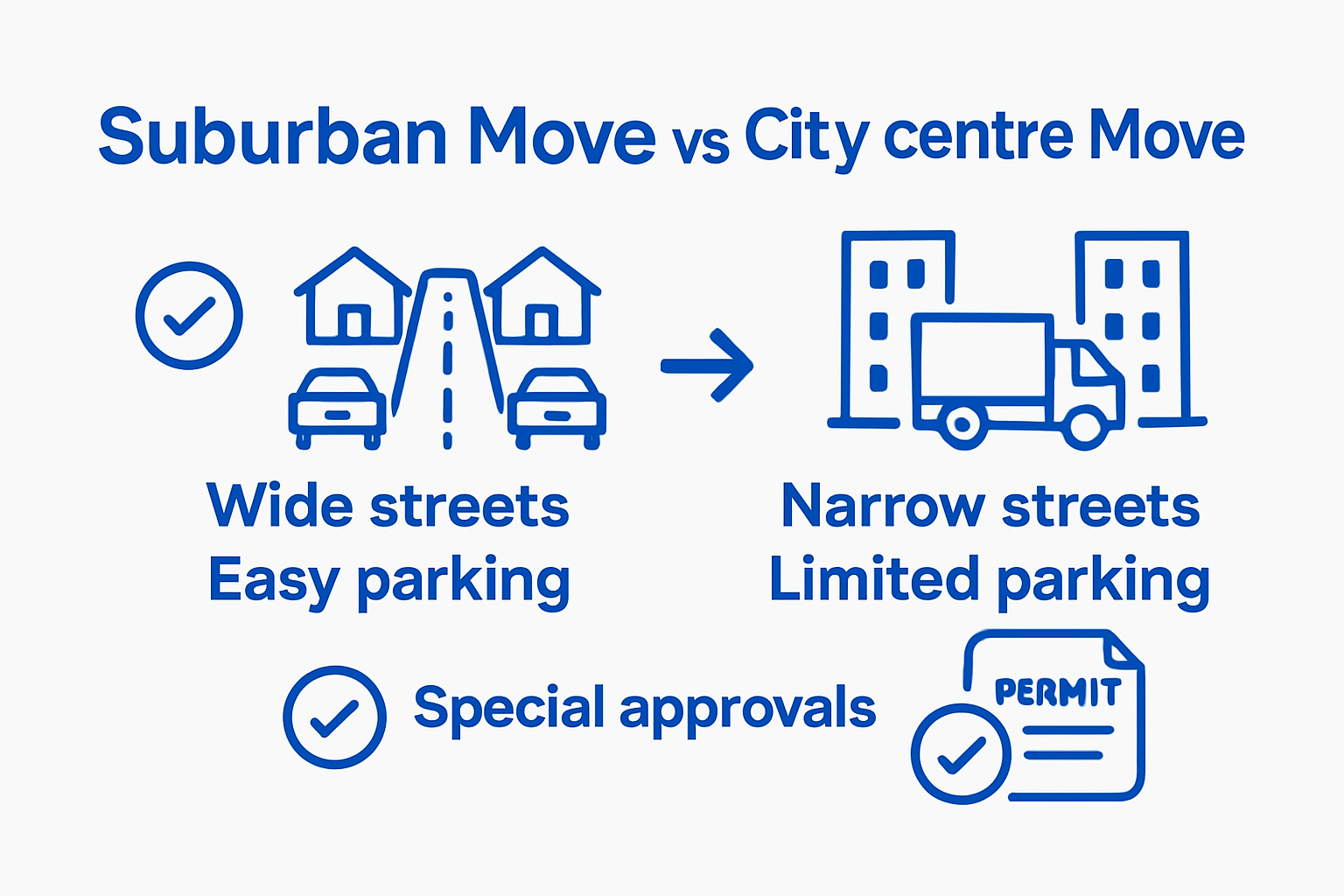
Professional removals firms operating in city centres must invest in specialised equipment and develop unique expertise. Compact furniture, modular moving techniques, and precision navigation become critical skills. Professionals require smaller, more manoeuvrable vehicles, lightweight moving equipment, and teams trained in negotiating complex urban moving scenarios.
According to Columbia Residential, urban buildings typically impose strict requirements including:
Successful city centre moves demand a combination of strategic planning, technical expertise, and adaptable problem-solving skills. Understanding these unique challenges helps both movers and clients prepare for a smooth urban relocation experience.
To help clarify the distinct difficulties faced during urban relocations versus suburban moves, the following table compares major aspects of each moving scenario.
| Aspect | Urban City Centre Moves | Suburban Moves |
|---|---|---|
| Parking & Loading Zones | Extremely limited, permit needed | Plentiful, generally unrestricted |
| Building Access | Strict regulations, time-limits | Often flexible, less restricted |
| Space Constraints | Narrow corridors, small lifts | Wider doors, larger spaces |
| Permit Requirements | Multiple permits often required | Rarely needed |
| Moving Equipment | Specialised, modular, compact | Standard equipment usually sufficient |
| Scheduling | Precise timing, brief windows | Greater scheduling flexibility |
| Risk Level | High (property damage, delays) | Moderate |
Urban relocations represent a complex logistical challenge that demands precision, strategic planning, and specialised knowledge far beyond traditional moving approaches. Professional removals firms must orchestrate multiple intricate elements to successfully navigate the unique constraints of city centre environments.
Successful urban relocations begin long before the moving day. Comprehensive pre-move planning involves detailed site assessments, building management negotiations, and precise logistical mapping. Learn more about our expert urban moving strategies to understand the critical preparation stages.
Critical pre-move coordination elements include:
Urban relocations require advanced technical skills and specialised resources. Professional moving teams must possess in-depth knowledge of complex urban infrastructure, building regulations, and innovative moving techniques. According to Philadelphia Department of Streets, successful urban moves demand meticulous permit management and strategic planning.
Key technical considerations encompass:
Professional removals firms operating in urban environments must continuously adapt their strategies, invest in specialised training, and develop robust communication protocols. The ability to anticipate and rapidly respond to unexpected challenges distinguishes exceptional urban moving services from standard relocation approaches.

City centre relocations represent a complex landscape of logistical challenges that demand specialised professional intervention. Unlike straightforward suburban moves, urban relocations require intricate planning, technical expertise, and strategic problem-solving skills that go far beyond basic transportation of household items.
Professional removals firms provide critical risk management throughout the urban moving process. Discover why expert support transforms your moving experience and understand the comprehensive protection they offer. These professionals mitigate potential challenges through meticulous pre-move assessments and comprehensive planning strategies.
Key risk management considerations include:
Urban moves demand advanced technical capabilities that amateur movers simply cannot replicate. According to NIOSH ergonomic research, professional moving teams are trained to manage complex lifting scenarios while minimising potential injury risks.
Professional support provides critical advantages such as:
Professional removals firms operating in city centres represent more than simple transportation services. They are strategic partners who transform potentially stressful relocations into smooth, controlled transitions, protecting clients’ belongings and minimising potential complications through expert knowledge and sophisticated operational approaches.
Moving into a bustling city centre apartment involves navigating a complex web of logistical challenges that require meticulous planning and strategic preparation. Unlike traditional residential relocations, urban moves demand a comprehensive understanding of unique environmental and regulatory constraints.
Successful urban relocations begin with understanding and meeting specific building management protocols. Explore our comprehensive moving day preparation guide to ensure you’re fully prepared for the intricate requirements of city centre moves.
Critical administrative considerations include:
Urban apartment moves require precise spatial analysis and strategic planning. According to Boston’s municipal guidelines, successful city relocations demand advance preparation for curb access and loading zones.
Key logistical planning elements encompass:
Professional removals firms specialising in urban relocations understand that each city centre move represents a unique puzzle. They combine technical expertise, municipal knowledge, and strategic planning to transform potentially complex moves into seamless transitions, ensuring clients can focus on the excitement of their new urban living experience.
The table below summarises key administrative, planning, and logistical considerations vital for moving into a busy city centre apartment, highlighting the actions and their corresponding importance.
| Consideration | Purpose | Why It Matters |
|---|---|---|
| Building access permissions | Obtain authorisation from management | Prevents delays and ensures move compliance |
| Parking and loading zone permits | Secure short-term access for moving vehicles | Avoids fines and logistical bottlenecks |
| Accurate measurements of access | Assess doorways, corridors, lifts | Ensures large items will fit, saving time |
| Coordination with management | Inform, arrange lift bookings, clarify procedures | Prevents conflicts with other residents |
| Insurance documentation | Provide proof to building and removals team | Protects against liability during the move |
| Time window restrictions | Understand and respect scheduled move times | Respects building regulations and resident routines |
| Advance notice of activities | Communicate schedule and expectations | Fosters cooperation and efficient coordination |
Urban relocation requires intricate navigation through a complex landscape of municipal regulations, building protocols, and logistical constraints. Professional removals firms must demonstrate exceptional knowledge of local requirements to ensure seamless, compliant moves within densely populated city centres.
Successful city moves depend on understanding and securing appropriate municipal permissions. Explore our comprehensive guide to local moving regulations to comprehend the nuanced requirements of urban relocations. Each city centre presents unique regulatory challenges that demand precise administrative preparation.
Key municipal regulatory considerations include:
Urban infrastructure presents complex access challenges that require strategic planning and specialist knowledge. According to Boston municipal guidelines, successful city relocations demand comprehensive understanding of local infrastructure limitations.
Critical infrastructure planning elements encompass:
Professional removals specialists recognise that each city centre move represents a unique regulatory puzzle. By combining deep municipal knowledge, technical expertise, and strategic planning, they transform potentially complex regulatory landscapes into smooth, compliant moving experiences.
Moving into a busy city centre apartment in Newcastle brings unique headaches. Narrow streets, strict parking rules, limited lift access, and tight hallways can quickly turn excitement into stress. You deserve a removals team that knows the local landscape and understands how to handle the most challenging city centre scenarios.
Explore real stories from clients who have faced the same Newcastle city centre obstacles in our Testimonial Showcase and discover how they successfully relocated with our help.
Schott Removals is here to help you navigate city-specific requirements. With over 30 years of moving experience, we use proven strategies and specialised equipment to simplify even the most complex apartment relocations. Read recent customer feedback in our Testimonials, then visit Schott Removals to get your personalised quote. Book now and let our city centre specialists make your Newcastle move simple and worry-free.
Moving into a city centre apartment involves navigating limited parking, strict building access regulations, and tight living spaces. These challenges require careful planning and coordination.
Preparation for a city centre move includes obtaining building access permissions, securing parking permits, assessing access points, and coordinating with building management for specific move-in requirements.
Professional removals firms offer expertise in navigating complex urban environments, utilising specialised equipment, and ensuring compliance with local regulations, which helps mitigate risks and streamline the moving process.
Removals firms often use compact, manoeuvrable vehicles and lightweight equipment designed for navigating tight spaces. They may also employ modular packing techniques and precision tools for effective urban relocations.
Unit 20, Lingfield Point
McMullen Road,
Darlington
DL1 1RW
Telephone: 01325 487091
Email: info@schottremovals.co.uk