
Planning an office move in Darlington or across County Durham brings a unique set of challenges for office managers in smaller businesses. You must balance everyday demands with the huge task of coordinating staff, services, and your physical workspace. By focusing on a detailed schedule and structured planning process, you can reduce stress while guaranteeing nothing is missed as you prepare for a successful move in the North East.
| Key Message | Explanation |
|---|---|
| 1. Assess current and future space needs | Document your current workspace usage and project future requirements to avoid costly mistakes. |
| 2. Create an organised moving schedule | Develop a detailed checklist and timeline to ensure that every necessary task is completed on time. |
| 3. Coordinate communication with staff | Keep your team and service providers informed to reduce anxiety and ensure smooth operations during the move. |
| 4. Pack systematically and label clearly | Use a consistent labelling system to prevent loss and damage, ensuring everything is accounted for during the move. |
| 5. Verify functionality at new office | Confirm that all systems and utilities are operational before staff arrive to prevent disruptions in business continuity. |
Before you move your office, you need to understand exactly what space you’re using now and what you’ll actually need in the future. This isn’t just about counting desks or measuring square footage. It’s about understanding your business operations and planning for growth or change over the next few years.
Start by documenting your current space usage. Walk through your existing office and note down what each area does. Do you have separate meeting rooms, a break area, storage for files or equipment, or dedicated quiet spaces for focused work? In Darlington and across County Durham, many small to medium-sized businesses are discovering they’ve outgrown their current spaces or are actually using far less than they’re paying for.
Measure your actual footprint, including:
Next, project your future needs over the next three to five years. Will you hire more staff? Are you planning to introduce hot-desking or flexible working arrangements? The National Planning Policy Framework provides guidance on assessing future operational requirements to ensure organisations plan for sufficient space sustainably over time.
Think about how your business operates now versus how you want it to operate. Remote work has changed everything. Some teams need fewer desks because staff rotate in. Others need more collaboration space and fewer individual workstations.
Your future space needs should reflect your business strategy for the next three to five years, not just your current headcount.
Document any equipment or storage that consumes significant space. Printers, filing cabinets, server equipment, and product stock all matter. If you’re planning to reduce these through digitalisation or outsourcing, that changes your space calculation considerably.
Consult with your team about what works and what doesn’t. Employees know where bottlenecks happen. They’ll tell you if meeting rooms are always booked or if everyone works better in open areas.
To clarify how different workspace types support business goals, here is a comparison of their features and impacts:
| Workspace Type | Main Benefit | Ideal For | Business Impact |
|---|---|---|---|
| Open Plan | Enables flexible layouts | Collaborative teams | Promotes teamwork and adaptability |
| Dedicated Offices | Supports privacy | Executives, HR, finance | Enhances confidentiality |
| Hot-Desking | Maximises space efficiency | Part-time or remote workers | Reduces costs, increases flexibility |
| Meeting Rooms | Facilitates group sessions | Project teams, clients | Improves communication |
| Quiet Zones | Minimises distractions | Creative and analyst staff | Boosts concentration and output |
Pro tip: Create a simple spreadsheet documenting current usage by department or function, then add a column for projected needs in three years—this becomes invaluable when comparing potential new properties and ensures you don’t repeat mistakes in your next location.
A thorough moving schedule and checklist keeps everything organised and prevents you from forgetting critical tasks. Without one, you’ll scramble at the last minute and risk service interruptions that harm your business.
Start by working backwards from your moving date. If you’re moving in eight weeks, what needs to happen in week one? The step-by-step guide on creating a moving schedule emphasises forming a moving team, decluttering, securing essentials like internet and security services, and finalising your new office design.
Break your timeline into phases:
Create a master checklist that covers every business function. Notify your bank, HMRC, Companies House, and any professional bodies about your address change. This matters in the North East just as much as anywhere else.
Address postal redirection with Royal Mail at least three weeks before moving. Arrange for your internet service provider to transfer or install connections at your new address. Contact your current and new property insurers to update your details.
A detailed checklist prevents panic and ensures nothing falls through the cracks during the busiest week of your business year.
Assign responsibilities to team members. One person might handle IT logistics, another manages post redirection, and someone else coordinates with removals companies. Clear ownership prevents duplicated effort and missed tasks.
Update your checklist weekly and mark off completed items. This gives you confidence and visibility as moving day approaches. For a Darlington-based business moving locally, this rhythm keeps momentum going.
Pro tip: Use a shared spreadsheet or project management tool so your entire team can see progress in real time, reducing confusion and ensuring nothing gets delegated twice.
Successful office moves depend on clear communication with your team and every service provider involved. Without coordination, you’ll face disconnected utilities, missed IT setups, and confused staff on moving day.
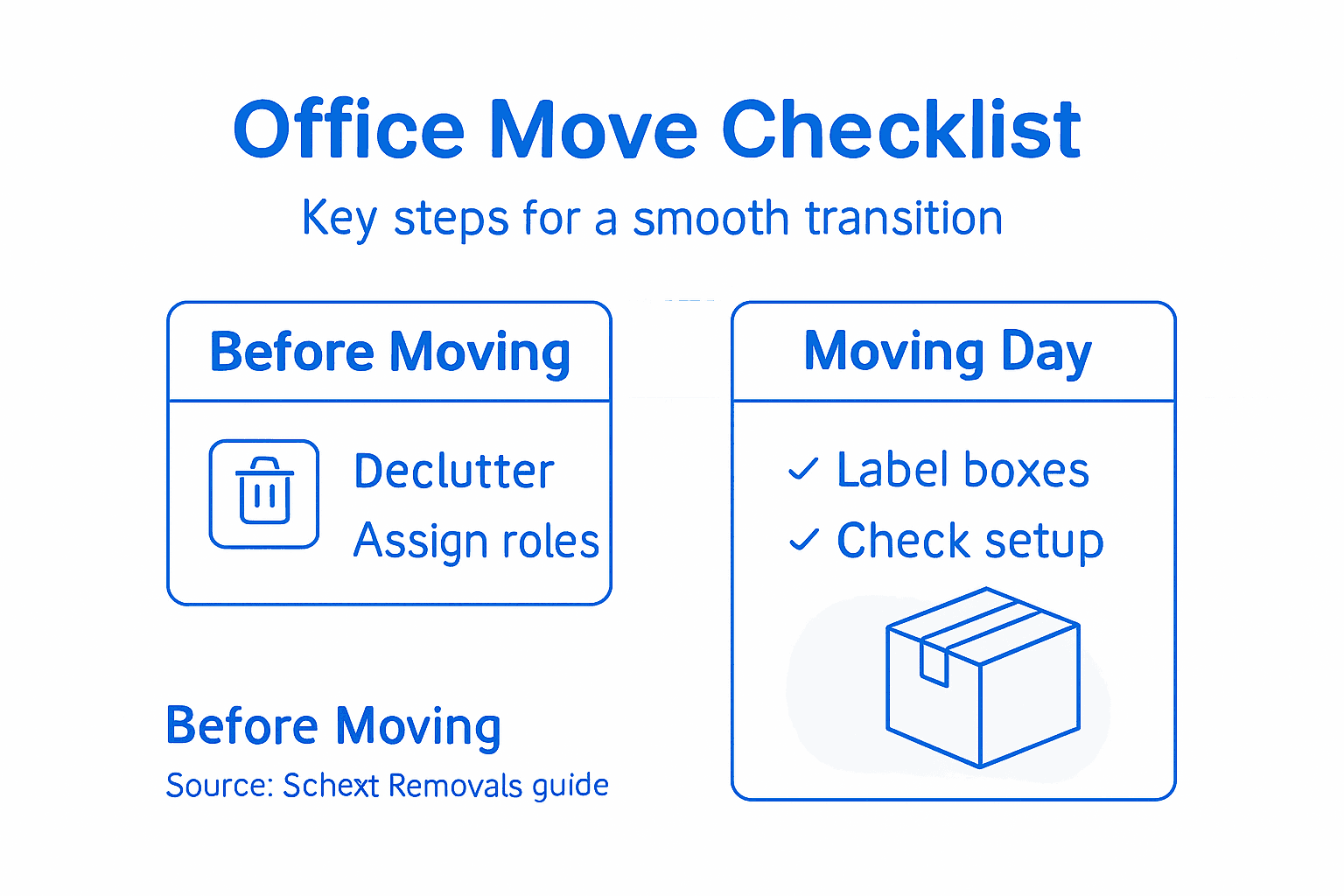
Start by holding a team meeting to explain the move timeline and what it means for each person. Will staff be working from home on moving day? Will the office close temporarily? Be transparent about disruptions and answer questions honestly.
Create a communication schedule that keeps everyone informed throughout the process. Send updates fortnightly at first, then weekly as moving day approaches. Staff who feel informed are less anxious and more helpful during transitions.
Coordinate with essential service providers in this order:
Your office manager plays a crucial role in managing vendor relationships and liaising with service providers to ensure continuity during the move. Assign this person clear authority and give them a master contact list for all providers.
Confirm every arrangement in writing. Email confirmations with dates, times, and contact numbers. Ask providers to confirm receipt. This prevents misunderstandings when moving day arrives, particularly important for businesses relocating within Darlington or County Durham.
Coordinate in writing and confirm every single arrangement, no matter how small.
Two weeks before moving, conduct a final check with each provider. Verify internet installation dates, utility disconnection times, and waste collection schedules. Address any last-minute issues before they become crisis situations.
Brief your staff one week before moving. Tell them what to pack, what stays, where to report on moving day, and what time they can return to the new office. Clear expectations reduce confusion and stress.
For a clear overview of essential service coordination during an office move, consult the following reference:
| Service Provider | Coordination Timing | Key Consideration | Business Risk if Missed |
|---|---|---|---|
| Internet Provider | Two weeks pre-move | Installation and connectivity | Downtime, lost emails |
| Utilities | Immediately post-move | Address transfer and billing | No heating/lighting on arrival |
| Security Company | One week pre-move | Alarm and access setup | Vulnerable premises |
| Cleaners | Before staff arrive | Deep cleaning scheduling | Unhygienic environment |
| Waste/Recycling | First week post-move | Bin and collection arrangements | Overflowing rubbish, compliance |
Pro tip: Create a shared contact spreadsheet with names, phone numbers, and confirmation dates for every service provider so any team member can quickly reference critical information during the moving period.
Proper packing and labelling prevents damage, loss, and data breaches during your move. Careless packing can destroy expensive equipment or expose sensitive business information, which is why this step demands careful attention.

Start by decluttering before you pack anything. Go through every desk, drawer, and storage area and decide what actually needs to move. Old files, broken equipment, and obsolete supplies just add weight and cost. Be ruthless about what stays behind.
Use the clear desk policy to get your team involved. Everyone packs their own workspace, which means they know exactly what’s in their boxes and nothing gets forgotten. Provide packing supplies and clear instructions for every department.
Label everything consistently using this system:
Handle sensitive documents with special care. According to guidance on practical methods for destroying documents, organisations must securely dispose of confidential paperwork to protect personal data during office moves.
Sort documents into three categories before packing. Keep active files that your business needs regularly. Archive historical records in secure storage. Shred or securely dispose of anything you’re legally allowed to discard. This reduces what you move and protects your business.
For IT equipment, photograph cable connections before disconnecting anything. Label cables clearly so your IT team can reconnect everything correctly at your new location. Damaged cables cause delays that can take days to troubleshoot.
Secure packing and clear labelling prevents lost equipment, damaged items, and data breaches.
Create a master inventory spreadsheet tracking every box number, its contents, which department it belongs to, and its destination. Share this with your removal company so they know where everything should go.
Pack boxes to a manageable weight, around 20 kilograms maximum. Heavy boxes are harder to move, easier to damage, and increase injury risk for your moving team and professional removals staff.
Pro tip: Pack a “Day One” box for each department containing essentials they’ll need immediately, like kettles, phones, stationery, and urgent files, so teams can function on moving day even if other boxes haven’t arrived yet.
Moving day excitement can mask serious problems. Before your team settles in, you need to systematically verify that everything works. A single overlooked issue can disrupt your entire business for days.
Start with IT systems and connectivity. Test your network before staff arrive. Can you access the internet? Do wireless networks broadcast properly? Can employees connect to printers and shared drives? Testing network connectivity and computer systems during relocation ensures that digital services remain operational and downtime is minimised.
Run through this verification checklist:
Verify security and data protection are properly configured. Check that access controls limit entry to authorised personnel. Confirm that security features and data protection policies are enforced at your new location to maintain regulatory compliance.
Test physical infrastructure next. Check that heating, cooling, and lighting work in every room. Run water taps, test electrical sockets, and verify that toilets function properly. These basic systems matter more than you think when dozens of people depend on them.
Walk through with your IT provider and facilities manager. Document any problems and get commitments for repairs within specific timeframes. Don’t accept vague promises.
Test everything before your team returns to work, not after problems frustrate people.
Conduct a full walkthrough with department heads. Have them check their specific areas and confirm everything they need is in place. Darlington businesses relocating locally should schedule this during off-hours if possible.
Brief your team on any temporary limitations. If Wi-Fi is slightly slower or a printer is in a different location, tell people beforehand so they’re not caught off guard on their first day back.
Pro tip: Create a simple feedback form for staff to report any issues in their first week, and assign someone to track and follow up on these problems to catch things your initial walk-through might have missed.
Planning an office move can feel overwhelming with so many details like assessing space needs, coordinating services, and packing securely. If you want to avoid downtime and stress, relying on professionals who understand these challenges is essential. Schott Removals brings over 30 years of experience helping businesses in Darlington and beyond achieve smooth relocations by handling complex logistics with care and precision.
Trust a family-run company that puts your needs first. From meticulous packing and secure storage solutions to local, national, and international removal services, Schott Removals offers tailored support every step of the way. They know how crucial detailed planning and coordination are to prevent disruptions and keep your operations running.

Ready to transform your moving experience? Visit Schott Removals today to explore their comprehensive moving services. Get your personalised quote online and start planning with confidence. Don’t risk costly delays or damaged equipment — choose a partner who makes your office move a success. Learn more about how their packing and storage options can simplify your move by visiting our main site.
Take control of your office relocation now and ensure a smooth transition backed by trusted expertise.
Before moving, carefully evaluate your existing office usage, including the types of spaces you have, such as meeting rooms and storage areas. Document your total floor area and plan for future growth by projecting needs over the next three to five years. Identify changes in work patterns, like remote work or flexible arrangements, to determine the right layout.
Develop a thorough moving schedule that outlines tasks leading up to the moving day, starting from weeks before the move. Itemise important tasks such as finalising the new location, notifying service providers, and arranging for utilities. Create a comprehensive checklist that holds everyone accountable for specific responsibilities.
Hold team meetings to communicate the moving timeline and address any concerns from your staff. Establish a regular communication schedule with updates as moving day approaches to keep everyone informed. Clearly explain responsibilities on moving day to reduce confusion and ensure a smooth transition.
First, declutter all workspaces by removing unnecessary items before packing. Use a clear labelling system that includes colour coding for departments and concise descriptions of contents for each box. Make sure sensitive documents are securely stored or disposed of according to data protection guidelines.
Before your team starts working at the new office, conduct a systematic walkthrough to test all IT systems, including internet and telecommunications. Ensure all physical infrastructure, like heating and lighting, is operational, and then address any discrepancies immediately to avoid downtime. Finalise this check-list two to four days prior to the team’s return to work.
Create a feedback mechanism for staff to report issues they face in the first week after the move. Assign someone to monitor these concerns and ensure timely resolutions. Regularly review and follow up on problems to maintain an efficient working environment.
Unit 20, Lingfield Point
McMullen Road,
Darlington
DL1 1RW
Telephone: 01325 487091
Email: info@schottremovals.co.uk