
Moving an office in Darlington can quickly turn chaotic when faced with complex desks, rows of filing cabinets, and a tangle of cables. Tackling each piece of furniture with care is vital for a secure transition, protecting your investment and sparing your team from unnecessary stress. This guide will walk you through each step, from gathering essential disassembly equipment to inspecting every component before you lock up your office for the final time.
| Essential Insight | Explanation |
|---|---|
| 1. Assemble necessary tools and materials | Gather an Allen wrench set, electric screwdriver, and protective gear to ensure smooth disassembly and prevent damage to furniture. |
| 2. Systematically document components | Create a detailed inventory with sketches or photographs to keep track of each furniture piece and its configuration for easier reassembly. |
| 3. Manage cables and small parts effectively | Label and photograph cables before disconnecting, and organise loose parts in ziplock bags to prevent damage during transit. |
| 4. Follow a careful disassembly process | Inspect furniture before dismantling, remove components slowly, and document each stage to avoid confusion during reassembly. |
| 5. Conduct a final inspection before transport | Verify that all items are securely packed, labelled, and protected to minimize potential damage during the moving process. |
Before diving into your office furniture disassembly project, you’ll need to collect the right tools and protective gear. Being well-prepared makes the entire relocation process smoother and helps prevent potential damage to your valuable equipment.
Start by assembling a comprehensive toolkit that includes essential disassembly equipment. Your toolkit should feature:
Pro tip: Always keep small hardware and screws together to avoid losing critical pieces during the move.
Protective materials are equally crucial when preparing to disassemble office furniture. You’ll want to safeguard both your furniture and your workspace from potential scratches or damage. Consider purchasing furniture blankets or bubble wrap to protect delicate surfaces and edges. In towns like Darlington and throughout County Durham, many local moving supply shops offer these materials at reasonable prices.
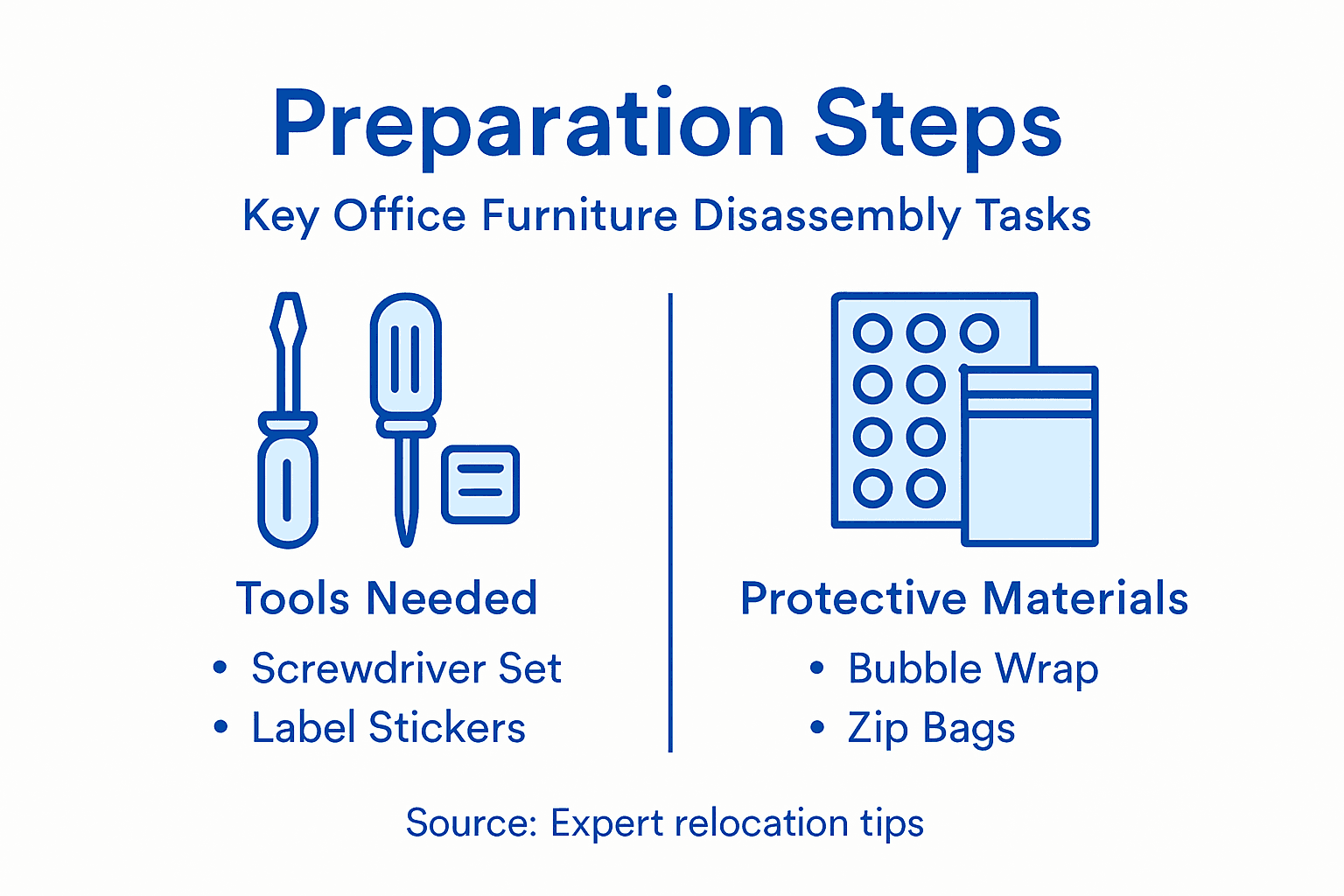
Here’s a concise summary of protective materials and their purpose:
| Material Type | Main Function | Ideal Usage Situation | Extra Benefit |
|---|---|---|---|
| Furniture blanket | Prevent scratches and dents | Large desks, cabinets | Added stability for transit |
| Bubble wrap | Cushion fragile surfaces | Glass panels, delicate parts | Shock absorption |
| Cardboard sheets | Edge protection | Corners, drawer fronts | Lightweight and flexible |
| Plastic covers | Dust and moisture barrier | Electronic devices, chairs | Quick application |
Professional recommendation: Label every component and bag of hardware immediately after disassembly to streamline your reassembly process later.
Successfully managing office furniture during relocation requires a methodical approach to identifying and categorising each piece. Your goal is to create a systematic process that ensures every component can be easily tracked and reassembled at your new location.
Begin by systematically documenting office furniture components with a comprehensive inventory. This involves:
Careful documentation prevents confusion during reassembly and helps maintain the integrity of your office furniture.
Prepare separate storage containers or labelled bags for different furniture types. Use colour-coded labels or numbered systems to distinguish between desk components, chair mechanisms, and shelving units. Place corresponding hardware like screws, bolts, and small brackets in clearly marked, sealed plastic bags alongside their respective furniture pieces.
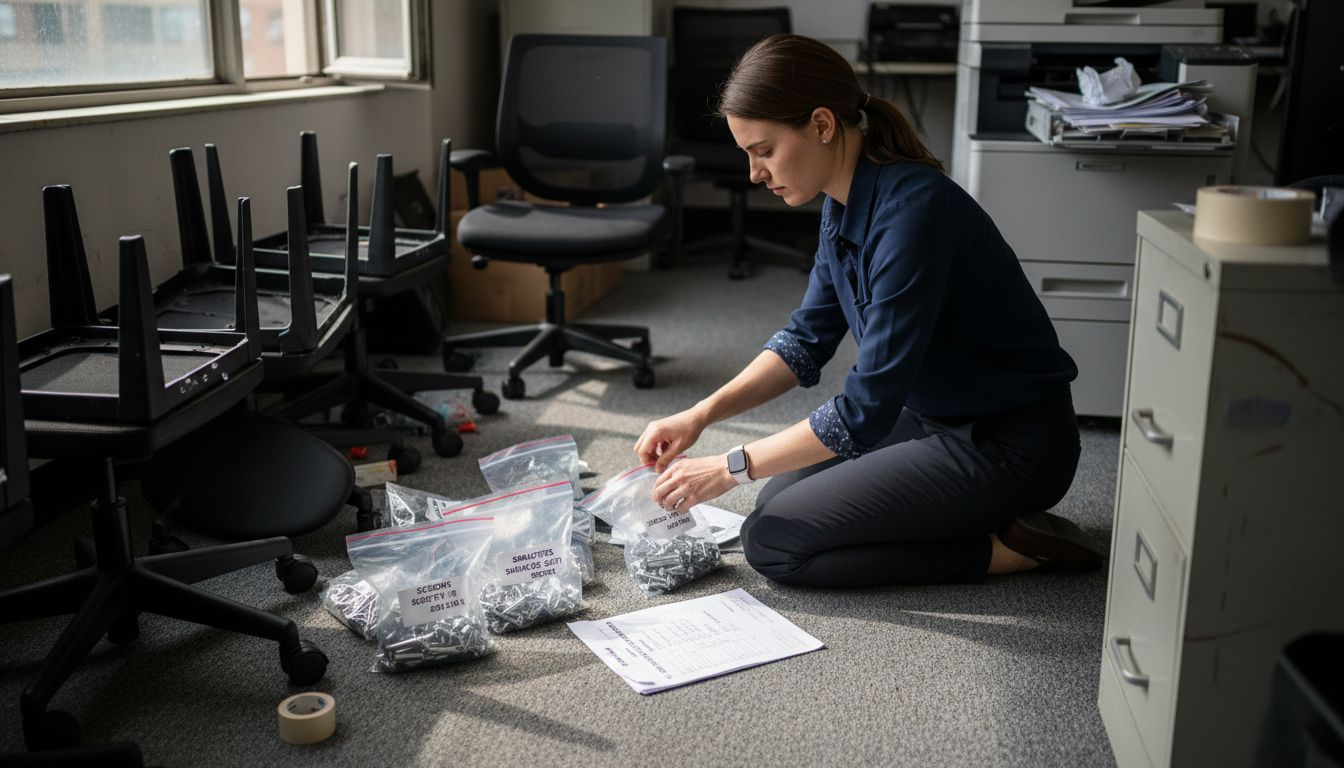
Compare colour-coded labelling versus numbered labelling for furniture organisation:
| Labelling Method | Ease of Identification | Best For | Potential Drawback |
|---|---|---|---|
| Colour-coded labels | Instantly distinguishable | Multiple furniture sets | May require pre-sorting |
| Numbered tags | Detailed organisation | Modular components | Confusion if tags lost |
Professional recommendation: Take high-resolution photographs of each furniture piece before disassembly, capturing intricate connections and original configurations to serve as a visual reference during reassembly.
Disconnecting electronic equipment and securing loose components is a critical step in preparing your office furniture for relocation. Your primary goal is to prevent damage to sensitive electronics and ensure all small parts remain intact during transit.
Begin by carefully unplugging all electronic devices. This process requires methodical attention to detail:
Proper cable management prevents equipment damage and simplifies reassembly at your new location.
For loose parts like drawer handles, shelving brackets, and modular components, use ziplock bags and clear labelling. Small plastic containers with compartments can also help organise hardware. In towns like Darlington, local office supply stores often stock organisational solutions perfect for this purpose.
Professional recommendation: Create a digital backup of your cable and component configurations by taking clear, well-lit photographs from multiple angles to serve as a comprehensive reassembly guide.
Disassembling office furniture requires a systematic approach to safely remove fixings and separate major structural components. Your objective is to methodically deconstruct each piece while minimising potential damage during the process.
Begin by carefully inspecting furniture dismantling techniques with these essential steps:
Slow and steady disassembly prevents unnecessary damage and ensures smoother reassembly later.
Prioritise removing detachable sections like desk drawers, shelves, and modular components first. For complex furniture with multiple connection points, take photographs at each stage to document the original configuration. In areas like County Durham, professional removal teams often recommend creating a visual record to assist with future reassembly.
Professional recommendation: Place unscrewed components in clearly labelled containers immediately after removal to maintain organisation and prevent misplacement.
Packing disassembled office furniture requires meticulous attention to detail and strategic organisation to ensure safe transportation and smooth reassembly. Your ultimate goal is to protect each component while maintaining a clear understanding of how pieces fit together.
Protect furniture during transit with these comprehensive packing strategies:
Systematic labelling prevents confusion and potential damage during relocation.
Develop a comprehensive labelling system that tracks each furniture piece’s origin and intended placement. Use colour-coded stickers or numbered tags to distinguish components from different furniture units. In regions like Darlington and County Durham, professional movers recommend taking detailed photographs of each piece before wrapping to provide additional reference for future reassembly.
Professional recommendation: Photograph furniture components before wrapping and store digital images in a cloud service or backup folder for easy access during reassembly.
Before loading your disassembled office furniture into the removal vehicle, conducting a thorough final inspection is crucial to prevent potential damage during transit. Your comprehensive check will ensure every component is secure, protected, and prepared for transportation.
Furniture inspection services recommend a systematic verification process with these critical steps:
Meticulous inspection prevents potential damage and ensures a smoother relocation experience.
Examine each packed item systematically before loading. In areas like Darlington and County Durham, professional movers suggest rotating each wrapped component to check for any missed spots or potential weakness in packaging. Pay special attention to delicate surfaces and complex furniture pieces that might require additional protective measures.
Professional recommendation: Create a final checklist and physically walk through your packed items one last time, treating each piece as though it were your most valuable possession.
Disassembling office furniture can be overwhelming with challenges such as managing numerous fixings, disconnecting cables safely, and keeping parts organised. If you are aiming to avoid the stress of lost components or damaged equipment during your relocation, professional assistance can make all the difference. Schott Removals offers specialised solutions designed to handle these exact pain points so your move is seamless and damage-free.

Take the pressure off by partnering with a trusted, family-run company based in Darlington with over 30 years of experience. Whether you need help with careful disassembly and packing or want to ensure your valuable office pieces are inspected and securely transported, our team provides comprehensive removals and storage services both locally and internationally. Don’t risk costly mistakes and delays. Visit Schott Removals now to get a free quote and start your smooth office relocation journey today.
To disassemble office furniture, gather essential tools such as an Allen wrench set, electric screwdriver, adjustable spanner, and a rubber mallet. Ensure you also have protective gear like gloves and goggles to safeguard yourself during the process.
Organise furniture components by creating labelled bags or storage containers for different furniture types, using colour-coded labels or numbers. This method helps track each piece and its corresponding hardware, reducing the chances of misplacement during relocation.
Start by carefully tracing each cable to its device, taking photographs for reference, and labelling them with tape or tags. Gently unplug the cables, winding them loosely to prevent damage, and store them securely to ensure a smooth reassembly process.
Pack disassembled furniture by wrapping each component in bubble wrap and using sturdy moving boxes that are suitable for the size of the parts. Clearly mark fragile sections with warning labels and create an inventory list to track all items as you pack them for transit.
Conduct a thorough inspection by checking that all wrapped components are secure, verifying that hardware bags are sealed, and ensuring that no sharp edges are exposed. Double-check the labelling on each package to prevent confusion during the reassembly at your new location.
Take high-resolution photographs of each furniture item at every disassembly stage, capturing details of the connections and configurations. This visual documentation will serve as a guide for reassembly, making the process easier and faster once you arrive at the new location.
Unit 20, Lingfield Point
McMullen Road,
Darlington
DL1 1RW
Telephone: 01325 487091
Email: info@schottremovals.co.uk