
Booking a move from Darlington or anywhere in the North East often brings a wave of questions and a fair amount of stress. Choosing the right survey can be the difference between smooth planning and last-minute surprises. Many confuse a moving survey with a basic inspection, but a moving survey assesses every detail and potential challenge at multiple stages, not just once. Here, you will discover what sets professional moving surveys apart and why they provide the clarity you need for a confident relocation.
| Point | Details |
|---|---|
| Understanding Moving Surveys | Moving surveys offer a detailed assessment of relocation logistics, extending beyond simple property inspections to encompass social and economic factors. |
| In-Person vs. Virtual Surveys | Both types of moving surveys have unique advantages, with in-person assessments providing accuracy and virtual surveys offering flexibility. |
| Preparation is Key | Clients should prepare by listing items and noting special requirements to ensure a comprehensive assessment and avoid pitfalls during the survey. |
| Cost Influencers | Survey costs vary based on property size, complexity, and specific needs, making accurate communication essential for effective budgeting. |
A moving survey is a comprehensive professional assessment designed to evaluate the logistics, conditions, and potential challenges associated with relocating assets, whether residential or commercial. Unlike standard inspections, these surveys provide an in-depth analysis that captures nuanced details throughout the entire moving process.
Most people misunderstand moving surveys, assuming they are simple walk-throughs or generic checklists. However, detailed transition research reveals they are far more complex, involving multifaceted data collection about social, economic, and spatial factors impacting household moves.
Key characteristics of a professional moving survey include:
The primary misconception is that moving surveys are interchangeable with basic property inspections. In reality, archaeological science principles demonstrate that moving surveys capture dynamic changes across multiple stages of relocation, providing a more nuanced understanding than static assessments.
Professional moving surveys distinguish themselves by offering:
A moving survey is not just about measuring items, but understanding the entire journey of relocation.
Pro tip: Request a comprehensive moving survey at least four weeks before your planned relocation to ensure thorough preparation and minimise unexpected challenges.
Moving surveys have evolved significantly, offering two primary approaches: traditional in-person assessments and modern virtual evaluations. These methods serve the same fundamental purpose of assessing relocation requirements, but each brings unique advantages to the moving process.
UK household research demonstrates that both survey types have distinct characteristics, enabling moving professionals to provide tailored services based on client needs and technological capabilities.
Traditional in-person moving surveys involve a professional surveyor visiting the property directly to:
These surveys offer unparalleled accuracy, allowing surveyors to physically examine spaces, identify potential logistical issues, and provide immediate, contextual recommendations.

Virtual surveys have gained prominence, particularly during recent global health challenges. English Housing Survey insights reveal these digital assessments involve:
Virtual surveys provide flexibility and convenience while maintaining professional standards of assessment.
Key differences between in-person and virtual surveys include:
Pro tip: Choose your moving survey method based on your specific requirements, technological comfort, and the complexity of your relocation project.
To help you choose the right moving survey, here is a comparison of the two main types:
| Aspect | In-Person Survey | Virtual Survey |
|---|---|---|
| Level of Accuracy | Highest, physical inspection | High, reliant on digital tools |
| Convenience | Requires on-site appointment | Flexible, can be scheduled remotely |
| Interaction | Direct, face-to-face with surveyor | Remote, via video or online communication |
| Ideal for | Complex, large or unique moves | Simple, standard or time-limited moves |
| Potential Limitations | Scheduling and travel | Technology access and user proficiency |
A moving survey process is a systematic approach designed to comprehensively evaluate and plan for residential or commercial relocations. Government housing research reveals this method involves multiple strategic stages that ensure precise planning and execution of moving requirements.
The typical moving survey process unfolds through several carefully structured phases:
The initial phase involves direct communication between the moving professional and the client. During this stage, basic information about the property, volume of items, and specific moving requirements are discussed. Technical survey documentation emphasises the importance of collecting comprehensive background details to facilitate accurate planning.
The moving survey typically encompasses these critical components:
Every moving survey is a unique blueprint tailored to individual relocation needs.
Professional surveyors meticulously document every aspect of the potential move, including potential challenges such as narrow staircases, delicate antique furniture, or complex access requirements. This detailed approach ensures a smooth, well-planned relocation experience.
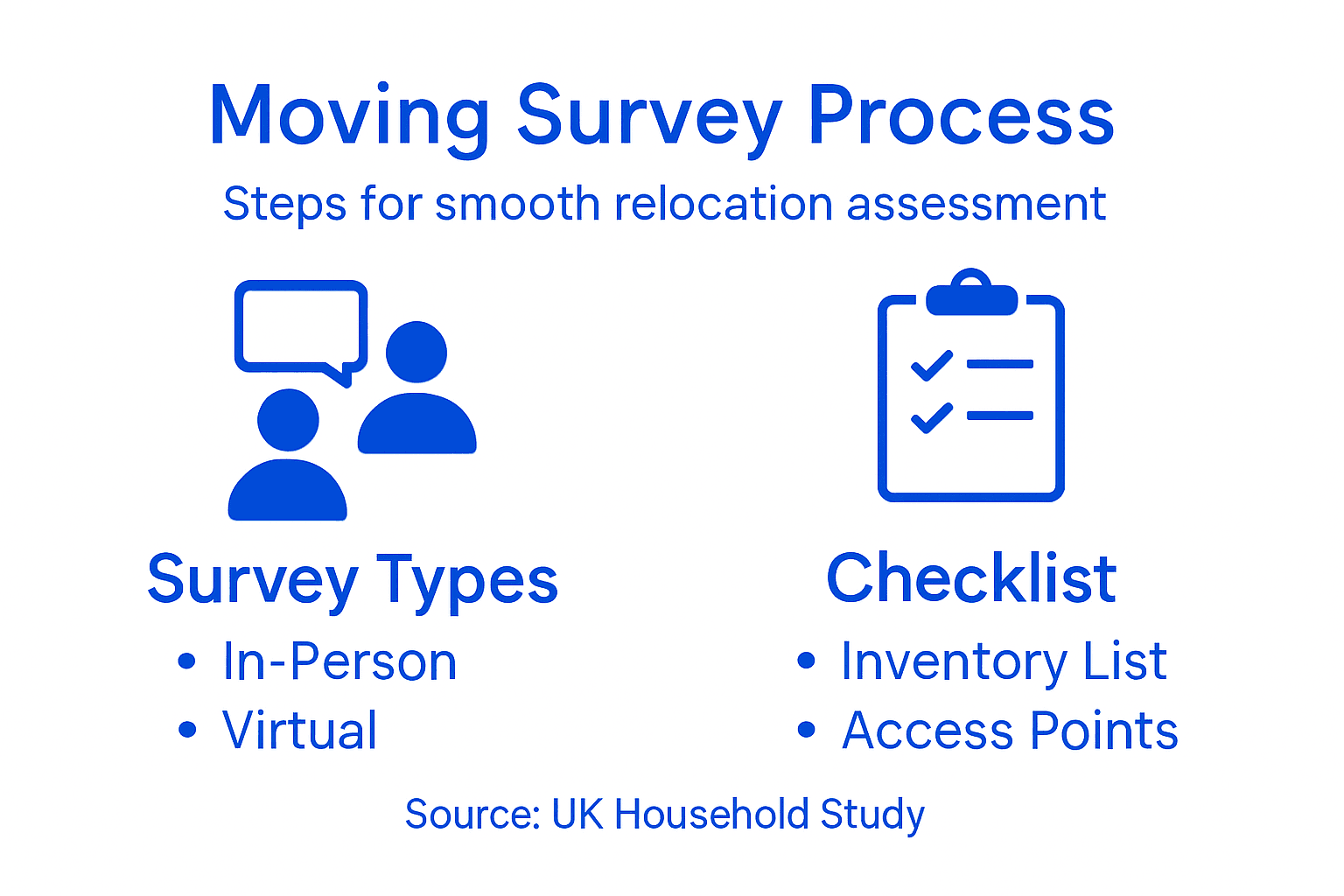
Pro tip: Prepare a comprehensive list of items, including any special or fragile possessions, before your moving survey to ensure the most accurate assessment possible.
A comprehensive moving survey explores multiple dimensions beyond simple physical measurements. Household demographic research demonstrates that surveyors gather intricate details to create a holistic understanding of relocation requirements.
The key areas and typical questions assessed during a moving survey typically encompass:
UK Household Longitudinal Study insights reveal that moving surveys delve deeply into understanding the broader context of a household’s transition, not merely the physical move.
Professional surveyors typically explore these critical areas through structured questioning:
A thorough moving survey uncovers nuanced details that significantly impact relocation strategy.
The questioning process goes beyond simple logistics, investigating factors such as family dynamics, work commitments, and potential future housing requirements. This comprehensive approach ensures that the moving plan is tailored precisely to the client’s specific circumstances and potential challenges.
Pro tip: Prepare comprehensive documentation about your current and future living spaces, including floor plans and specific item details, to facilitate a more accurate moving survey assessment.
Moving survey costs can vary significantly depending on property size, complexity, and specific requirements. Survey scheduling guidance indicates that comprehensive assessments typically range from £150 to £750 for residential properties, with more complex moves potentially incurring higher expenses.
Key factors influencing moving survey costs include:
Wildlife monitoring research highlights the importance of strategic scheduling to maximise survey effectiveness and minimise potential disruptions.
Professional moving surveys require careful navigation to ensure optimal outcomes:
Transparency and detailed preparation are crucial to a successful moving survey.
Most pitfalls stem from miscommunication or lack of comprehensive preparation. Clients should provide accurate, detailed information about their property, items to be moved, and specific requirements to ensure the most precise assessment possible.
For a clearer overview, the following table summarises common cost factors and pitfalls in moving surveys:
| Category | Example Influences | Potential Impact if Overlooked |
|---|---|---|
| Property Size | Large homes increase time and cost | Inaccurate budgeting |
| Item Complexity | Fragile or bulky items | Risk of damage, higher expense |
| Access Challenges | Narrow stairs, difficult loading zones | Delayed move, unexpected surcharges |
| Communication | Missing details in discussions | Misunderstandings, incomplete assessment |
| Preparation | Incomplete inventory, missing photos | Inaccurate quote, logistical surprises |
Pro tip: Create a comprehensive inventory list and photograph challenging access points or unique items before your survey to provide surveyors with the most accurate information possible.
Understanding what a moving survey involves is crucial to avoid unexpected challenges and hidden costs during your relocation. The detailed assessments outlined in the article highlight common pain points such as logistical hurdles, special item handling, and accurate volume measurement. At Schott Removals we take these concerns seriously by offering thorough moving surveys tailored to your unique needs. Our family-run company combines over 30 years of experience with professionalism and reliability to deliver a stress-free moving experience.
Discover the peace of mind that comes with expert support by requesting a comprehensive moving survey today. Visit Schott Removals to explore our full range of Testimonials Archives that showcase how we have helped clients overcome their moving challenges. Ready to plan your next move with confidence Read more about our approach in our Uncategorised Archives and get started now.
A moving survey is a comprehensive assessment that evaluates the logistics, conditions, and potential challenges associated with relocating assets, encompassing both residential and commercial moves.
Unlike standard property inspections, a moving survey captures dynamic changes across multiple stages of relocation and involves in-depth analysis, including risk evaluations and customised moving strategies.
The two primary types of moving surveys are in-person surveys, where a professional visits the property for a thorough assessment, and virtual surveys, which utilise digital tools for remote evaluations.
Requesting a moving survey at least four weeks before your planned relocation ensures thorough preparation, allowing for accurate cost estimation and identification of potential challenges, which can minimise unexpected issues during the move.
Unit 20, Lingfield Point
McMullen Road,
Darlington
DL1 1RW
Telephone: 01325 487091
Email: info@schottremovals.co.uk